
Quick Answer: The most durable rug materials for high-traffic areas include wool, nylon, and polypropylene, as they offer strong fiber resilience, wear resistance, and long-term performance. These materials withstand frequent use while maintaining structure, appearance, and resistance to stains and crushing.
Key characteristics that make these materials ideal include:
- High Fiber Strength: Resists breaking, fraying, and flattening under constant foot traffic
- Elastic Resilience: Fibers like wool and nylon bounce back after compression, preventing permanent wear
- Stain and Moisture Resistance: Especially in synthetic materials like polypropylene
- Low Maintenance Requirements: Easier cleaning and better performance over time
- Structural Stability: Maintains shape and texture even in busy areas
When combined with the right construction, these materials provide a balance of durability, practicality, and long-term value, making them suitable for areas like hallways, living rooms, and entryways.
High-traffic areas such as hallways, living rooms, and entryways experience constant movement, making them the most demanding zones for any rug. Unlike low-use spaces, these areas are exposed to repeated pressure, friction, and environmental factors that can quickly wear down less durable materials.
One of the most common issues homeowners face is premature rug deterioration, flattened fibers, fading colors, and visible wear patterns that appear much sooner than expected. This not only affects the space’s appearance but also reduces the investment’s overall value.
Did you know? Studies referenced by the Carpet and Rug Institute indicate that high-traffic zones can experience up to 5–10 times more wear than low-use areas, depending on footfall frequency and surface type.
Another challenge is the accumulation of dirt, moisture, and debris, which can weaken fibers over time if the material is not inherently resistant to these conditions. Rugs placed in entryways or family areas must handle both mechanical stress and environmental exposure, making material selection a critical factor.
Durable rug materials address these challenges by offering resilience, structural integrity, and resistance to wear, ensuring that the rug maintains its appearance and performance even under continuous use. Understanding what makes a material durable is the first step toward selecting a rug that can withstand daily wear and tear without compromising comfort or style.
What Makes A Rug Material Durable In High-Traffic Areas?
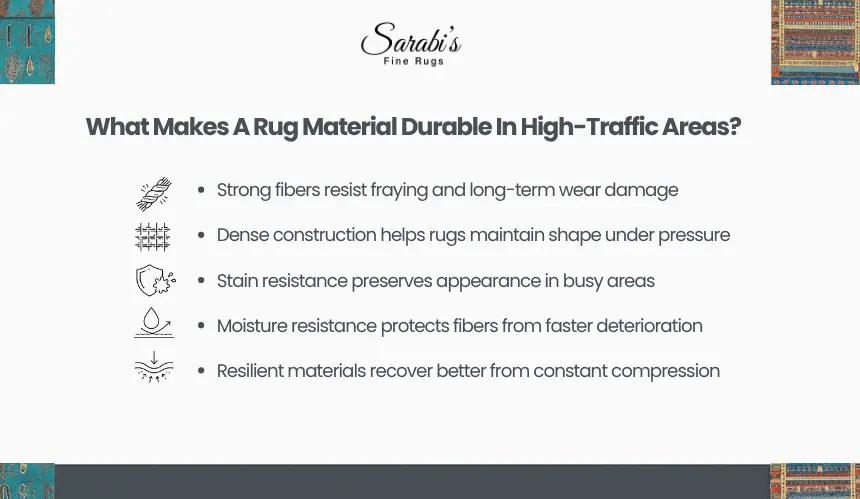
Durability in rugs is not defined by a single factor but by a combination of fiber properties, structural construction, and resistance to external stress. In high-traffic areas, rugs must withstand constant pressure, friction, and exposure to dirt without losing their shape or appearance. Understanding these technical factors helps explain why some materials last significantly longer than others.
How Does Fiber Strength Affect Rug Longevity?
Fiber strength determines how well a rug can resist breaking, fraying, or wearing down under repeated use. Stronger fibers maintain their integrity even under continuous foot traffic.
Materials such as nylon and wool are known for their high tensile strength, allowing them to withstand pressure without snapping or thinning. Weaker fibers, on the other hand, tend to degrade faster, leading to visible wear patterns and reduced lifespan.
Did you know? Fiber testing standards referenced by the American Society for Testing and Materials show that high-strength fibers can withstand significantly greater stress cycles before showing signs of wear, making them ideal for high-use environments.
Why Do Density And Construction Matter For Durability?
Beyond the material itself, how a rug is constructed plays a major role in its durability. Density refers to how tightly fibers are packed together, while construction determines how securely they are held in place.
- High-density rugs resist crushing and maintain their shape over time
- Tightly woven or knotted constructions prevent fibers from loosening or shedding
- Looser constructions tend to flatten more quickly under pressure
A well-constructed rug distributes weight more evenly, reducing localized stress and extending its lifespan.
How Do Stain And Moisture Resistance Influence Performance?
High-traffic areas are more likely to encounter spills, dirt, and moisture, all of which can degrade rug materials if not properly managed. Materials that resist absorption and staining tend to perform better over time.
Synthetic fibers like polypropylene naturally repel moisture, while wool has a protective outer layer that resists dirt penetration. This reduces the likelihood of permanent staining and helps preserve the rug’s appearance even with frequent use.
How Does Resilience Help Rugs Recover From Constant Pressure?
Resilience refers to a fiber’s ability to return to its original shape after being compressed. This is especially important in areas where rugs are subjected to repeated foot traffic or furniture weight.
Highly resilient materials prevent permanent flattening, ensuring that the rug retains its texture and visual appeal. Without this property, rugs can quickly develop worn paths and uneven surfaces.
Which Natural Rug Materials Offer The Highest Durability?
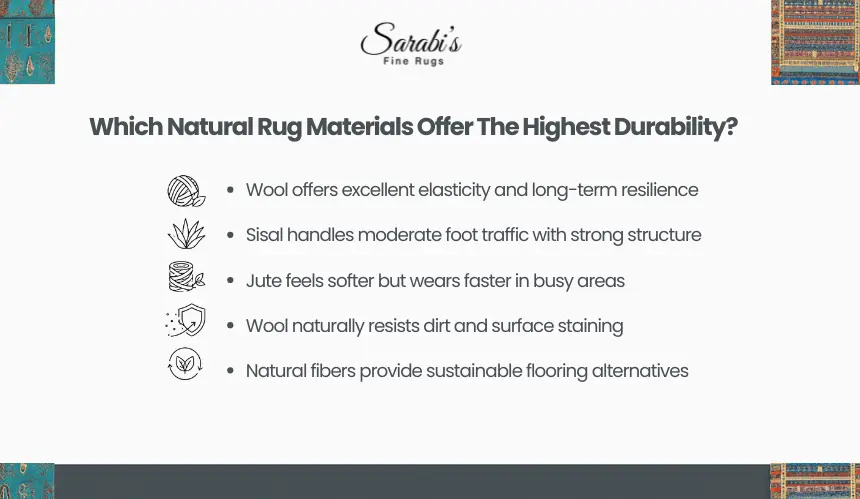
Natural rug materials are often valued for their texture, appearance, and sustainability, but not all of them perform equally in high-traffic areas. Some natural fibers offer excellent resilience and long-term durability, while others are better suited for low-use spaces due to their structural limitations.
Is Wool The Most Durable Natural Rug Fiber?
Wool is widely considered the most durable natural rug material due to its unique fiber structure. It has natural elasticity, allowing it to compress under pressure and return to its original shape without permanent damage.
Wool fibers are also naturally resistant to dirt and stains because of their outer protective layer, which helps prevent particles from penetrating deeply. This makes wool rugs particularly effective in maintaining their appearance even in frequently used areas.
Did you know? The International Wool Textile Organisation highlights that wool fibers can bend thousands of times without breaking, which contributes to their long lifespan in high-traffic environments.
How Do Sisal And Jute Perform In High-Traffic Spaces?
Sisal and jute are popular natural fibers known for their textured appearance and eco-friendly qualities. However, their performance in high-traffic areas differs significantly.
Sisal is relatively durable and has a firm structure that resists wear better than many other plant-based fibers. It can handle moderate foot traffic but may feel coarse underfoot. Jute, on the other hand, is softer but less durable, making it more suitable for low-traffic areas.
- Sisal offers better resistance to wear, but can be sensitive to moisture
- Jute provides comfort but tends to wear down more quickly in busy areas
What Are The Limitations Of Natural Fiber Rugs In High-Traffic Areas?
While natural materials offer several advantages, they also have limitations that can affect their performance under heavy use. These materials may require more careful maintenance and may not always withstand harsh conditions.
Natural fibers can be more prone to absorbing moisture and stains compared to synthetic alternatives. In addition, some materials may lack the resilience needed to recover from constant pressure, leading to visible wear over time.
Which Synthetic Rug Materials Are Best For Heavy Use?
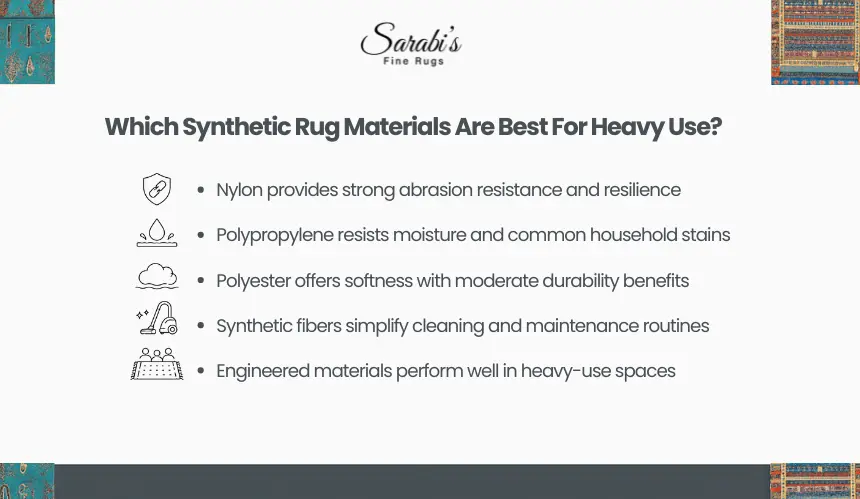
Synthetic rug materials are engineered to withstand heavy wear, making them a practical choice for high-traffic areas. These materials are designed to resist stains, maintain structure under pressure, and require less maintenance compared to many natural fibers.
Why Is Nylon Considered The Most Durable Synthetic Fiber?
Nylon is widely regarded as the most durable synthetic rug material due to its exceptional strength and resilience. Its fibers can withstand repeated compression without losing their shape, making it highly suitable for areas with constant foot traffic.
Nylon also offers strong abrasion resistance, helping prevent visible wear patterns over time. In addition, it maintains texture and appearance well, even after prolonged use.
Did you know? Industry testing referenced by the Carpet and Rug Institute shows that nylon consistently ranks among the highest-performing fibers in abrasion resistance tests, making it a preferred choice for heavy-use environments.
How Does Polypropylene Perform In High-Traffic Areas?
Polypropylene, also known as olefin, is valued for its resistance to moisture and staining. It does not absorb liquids easily, which makes it particularly effective in areas prone to spills or outdoor exposure.
While it may not match nylon in resilience, polypropylene performs well in maintaining color and resisting fading. It is often used in entryways, kitchens, and other spaces where durability and ease of cleaning are priorities.
Is Polyester Durable Enough For Frequent Use?
Polyester offers a balance between comfort and durability, though it is generally less resilient than nylon. It is known for its softness and vibrant color retention, making it a popular choice for aesthetic purposes.
In high-traffic areas, polyester can perform adequately if constructed with high density and low pile. However, it may show signs of compression more quickly than stronger fibers, especially in heavily used zones.
How Do Synthetic Fibers Compare In Terms Of Maintenance And Longevity?
One of the key advantages of synthetic materials is their ease of maintenance. Many synthetic fibers are designed to resist stains and simplify cleaning, which contributes to their long-term usability.
- Nylon offers the best balance of durability and resilience
- Polypropylene excels in moisture and stain resistance
- Polyester provides visual appeal with moderate durability
How Do Natural And Synthetic Rug Materials Compare In Durability?
Choosing between natural and synthetic rug materials often comes down to understanding how each performs over time. While both categories offer durability, they differ in how they handle wear, maintenance, and long-term performance in high-traffic environments.
Which Materials Last Longer Under Constant Foot Traffic?
In terms of raw durability, synthetic fibers such as nylon generally outperform most natural materials due to their engineered strength and abrasion resistance. They are specifically designed to withstand repeated pressure without degrading quickly.
Natural fibers like wool, however, offer a different type of durability. Instead of resisting wear through hardness, wool relies on elasticity and resilience, allowing it to recover from compression and maintain its structure over time. This makes wool one of the few natural fibers capable of competing with synthetics in high-traffic areas.
How Do Maintenance Requirements Differ Between Materials?
Maintenance plays a significant role in how long a rug lasts. Synthetic materials tend to be easier to clean and more stain-resistant, making them suitable for busy households where spills and dirt are common.
Natural materials, while durable, often require more careful maintenance. They may be more sensitive to moisture and require specialized cleaning methods to preserve their texture and integrity. This difference in upkeep can influence long-term performance depending on how the rug is used.
Which Materials Offer The Best Balance Of Cost And Durability?
Cost and durability are closely linked when selecting a rug for high-traffic areas. Synthetic materials are generally more affordable and provide consistent performance, making them a practical choice for heavy-use zones.
Natural materials, particularly wool, may involve a higher initial investment but can offer long-term value due to their longevity and ability to maintain appearance over time. The best choice depends on whether the priority is upfront cost, long-term durability, or a balance between the two.
Did you know? Industry comparisons referenced by the Carpet and Rug Institute indicate that nylon rugs often lead in durability tests, while wool ranks among the top natural fibers for long-term resilience.
How Do Rug Construction And Design Affect Durability?
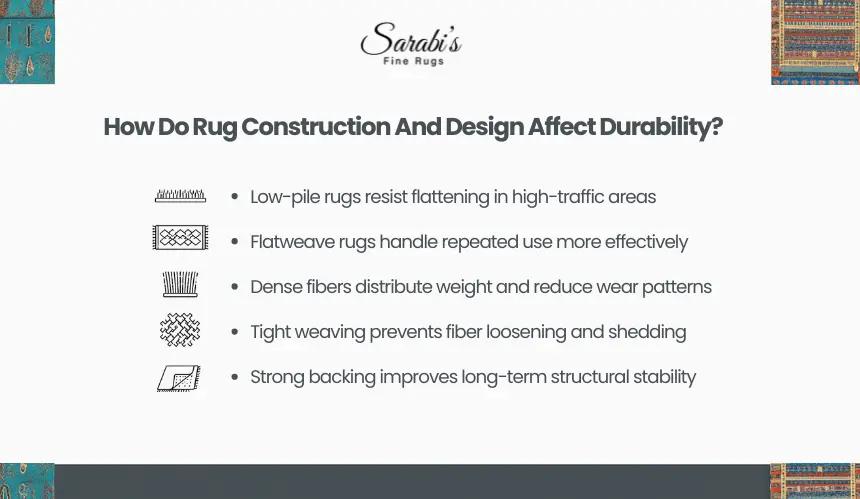
While material plays a major role in durability, construction and design determine how well a rug performs under continuous stress. Even high-quality fibers can wear quickly if the rug is poorly constructed, whereas well-built rugs distribute pressure evenly and maintain their structure over time.
Does Pile Height Influence Wear Resistance?
Pile height refers to the length of the fibers on the rug’s surface and directly impacts durability in high-traffic areas. Low-pile rugs tend to perform better because their shorter fibers are less prone to bending, matting, or trapping dirt.
High-pile rugs, while softer, can flatten more quickly under repeated use and may show wear patterns sooner. In busy areas, a lower pile height helps maintain a consistent appearance and reduces long-term damage.
How Do Flatweave Rugs Perform In High-Traffic Areas?
Flatweave rugs are constructed without a raised pile, which makes them highly durable and resistant to wear. Their tightly woven structure allows them to handle frequent use without significant compression or distortion.
These rugs are particularly effective in areas such as hallways and entryways, where constant foot traffic requires a stable, resilient surface. Their design also makes them easier to clean, which contributes to long-term performance.
Why Does Fiber Density Matter For Long-Term Use?
Density refers to how closely fibers are packed together within the rug. Higher density increases durability by allowing the rug to better absorb pressure and resist deformation.
- Dense rugs distribute weight more evenly, reducing stress on individual fibers
- Tightly packed fibers are less likely to loosen or shed over time
Did you know? Textile performance studies indicate that higher-density rugs can maintain their structure significantly longer under repeated stress, making density a key factor in durability.
How Does Backing And Weave Type Affect Structural Stability?
The backing and weave of a rug determine how securely the fibers are held in place. Strong backing materials and tight weaving techniques prevent fibers from shifting, loosening, or detaching over time.
Hand-knotted and tightly woven rugs generally offer superior durability compared to loosely constructed alternatives. A stable foundation ensures that the rug maintains its integrity even under heavy use.
Which Rug Materials Are Best For Specific High-Traffic Areas?
Different high-traffic areas place different types of stress on rugs, which means no single material performs best in every situation. The ideal choice depends on factors such as foot traffic intensity, exposure to dirt or moisture, and how the space is used on a daily basis.
What Works Best For Hallways And Entryways?
Hallways and entryways experience the highest level of foot traffic and are often exposed to dirt, moisture, and debris from outside. Rugs in these areas must prioritize durability and ease of maintenance.
Materials like polypropylene and nylon perform particularly well because they resist moisture, stains, and abrasion. Their ability to handle repeated use without significant wear makes them suitable for these demanding zones.
Which Materials Are Ideal For Living Rooms And Family Areas?
Living rooms and family spaces require a balance between durability and comfort. These areas are used frequently but also serve as spaces for relaxation and social interaction.
Wool and nylon are strong choices here, as they combine resilience with a comfortable feel underfoot. Wool offers natural elasticity and warmth, while nylon provides high wear resistance and maintains its structure over time.
What Are The Best Options For Homes with Pets and Kids?
Homes with pets and children pose additional challenges, including spills, stains, and constant movement. Rugs in these environments must be both durable and easy to clean.
Synthetic materials like polypropylene and polyester are often preferred because they resist staining and are easier to maintain. These materials can handle frequent cleaning without significant damage, making them practical for active households.
Did you know? According to data cited by the Carpet and Rug Institute, certain synthetic fibers can absorb moisture significantly better than natural materials, reducing the likelihood of permanent staining in high-traffic environments.
How Do Outdoor And Indoor-Outdoor Rugs Perform In Busy Areas?
Indoor-outdoor rugs are designed to withstand extreme conditions, making them highly durable, even in high-traffic indoor areas. These rugs are typically made from materials like polypropylene, which can resist moisture, fading, and heavy wear.
Their robust construction allows them to perform well in spaces that experience both heavy use and environmental exposure, such as entryways or transitional areas.
What Should Be Considered When Choosing Durable Rug Materials?
Selecting a durable rug for high-traffic areas involves more than choosing a strong material. The decision should balance durability, comfort, maintenance, and long-term value to ensure the rug performs well under daily use without compromising practicality or design.
How To Balance Durability With Comfort And Style?
Durability often comes at the expense of softness, but modern materials and constructions allow for a balance between the two. For example, wool provides both resilience and comfort, while certain synthetic blends can offer durability with a softer feel.
The key is to match the rug’s purpose with the level of comfort required. Areas with constant movement may prioritize strength, while spaces used for relaxation may benefit from a slightly softer surface without sacrificing durability.
What Maintenance Factors Should Be Evaluated Before Choosing A Material?
Maintenance plays a critical role in preserving a rug’s lifespan. Materials that are difficult to clean or prone to staining may deteriorate faster in high-traffic environments.
- Synthetic fibers generally require less maintenance and resist stains more effectively
- Natural fibers may need specialized care to maintain their appearance
- Ease of cleaning becomes especially important in areas exposed to dirt or spills
Did you know? Cleaning frequency and material compatibility can significantly influence how long a rug maintains its appearance, with easier-to-maintain materials often lasting longer in busy households.
How Does Budget Influence Long-Term Durability?
Budget considerations often affect material selection, but focusing solely on upfront cost can lead to frequent replacements and higher long-term expenses. Investing in a more durable material may result in better value over time.
Higher-quality materials tend to maintain their structure and appearance longer, reducing the need for replacement. This makes durability an important factor when evaluating overall cost-effectiveness.
How Do Lifestyle And Usage Patterns Affect Material Choice?
Lifestyle factors determine how much stress a rug will endure on a daily basis. Homes with pets, children, or heavy foot traffic require materials that can handle frequent use and cleaning.
Choosing a rug that aligns with real-world usage ensures that it performs effectively over time. A material that works well in theory may not be suitable if it cannot withstand the demands of the environment in which it is used.
Frequently Asked Questions
What is the most durable rug material for high-traffic areas?
Nylon is generally considered the most durable rug material due to its high strength and resilience. Wool is the most durable natural option, while polypropylene performs well in areas exposed to moisture and frequent use.
Are synthetic rugs more durable than natural rugs?
Synthetic rugs are typically more resistant to stains, moisture, and abrasion, making them highly durable in high-traffic areas. However, natural materials like wool offer strong resilience and can also perform well with proper maintenance.
How long do rugs last in high-traffic areas?
Rug lifespan depends on material and construction, but durable rugs made from nylon or wool can last 5 to 15 years or more with proper care. Lower-quality materials may show wear much sooner in busy areas.
What type of rug is best for homes with pets and kids?
Synthetic materials such as polypropylene and polyester are ideal for homes with pets and children because they resist stains, are easy to clean, and can handle frequent use without significant damage.
Do low-pile rugs last longer than high-pile rugs?
Low-pile rugs generally last longer in high-traffic areas because their shorter fibers are less likely to flatten or trap dirt. This makes them more resistant to wear and easier to maintain over time.