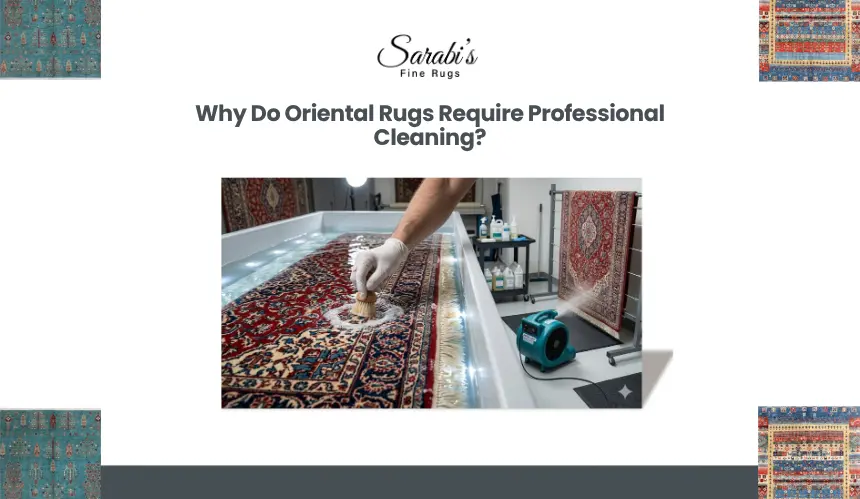
Quick Answer: Oriental rugs require professional cleaning because their hand-knotted construction, natural wool or silk fibers, and plant-based dyes react differently to moisture, detergents, and agitation than machine-made carpets. Embedded grit can cut fibers from within, improper drying can cause shrinkage, and harsh chemicals can trigger dye bleeding. Professional rug cleaning uses controlled washing, pH-balanced solutions, and fiber-specific drying methods to preserve structural integrity, color stability, and long-term value.
An oriental rug may look sturdy, but beneath its intricate patterns lies a dense network of hand-tied knots, natural wool or silk fibers, and plant-based dyes that react unpredictably to moisture and chemicals. What works for synthetic carpet can quietly damage a hand-knotted textile.
Deep within the pile, dry soil grinds against fibers under daily foot traffic. Excess water can trigger dye bleeding or foundation shrinkage. Harsh detergents can strip wool of its natural oils. These risks are not always visible immediately, but they accumulate over time.
Professional cleaning is not about appearance alone. It is about protecting fiber integrity, preserving color stability, and preventing structural breakdown before it begins.
Next, we will examine what makes oriental rugs fundamentally different from machine-made carpets.
What Makes Oriental Rugs Structurally Different From Regular Carpets?
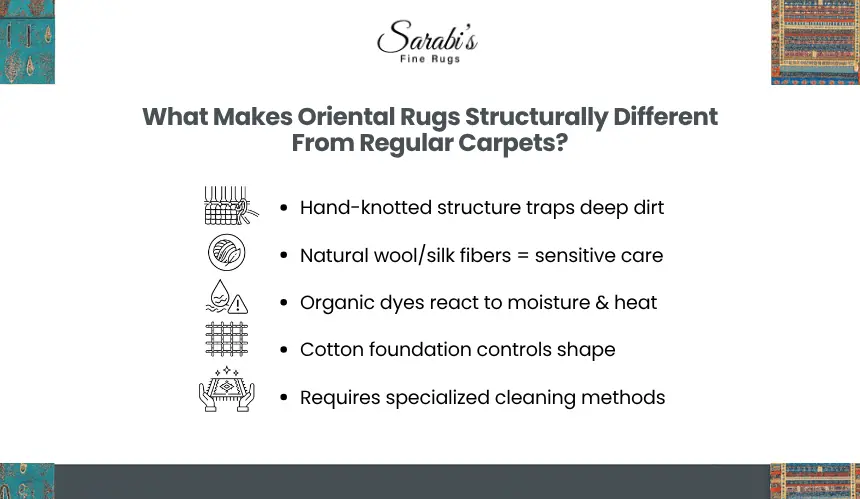
Oriental rugs are crafted by hand rather than through industrial tufting. Their internal structure, fiber composition, and dye systems differ significantly from those of synthetic, machine-made carpeting. Understanding this difference explains why they require a specialized cleaning methodology.
Hand-Knotted Construction and Fiber Density
Most authentic oriental rugs are hand-knotted, meaning every knot is individually tied around warp threads and secured by weft strands. Depending on origin, rugs can contain anywhere from 100 to over 800 knots per square inch. Higher knot density increases detail but also creates deeper soil retention zones.
Did you know? Industry textile studies show that up to 80 percent of particulate soil in rugs is dry, abrasive grit. In dense hand-knotted construction, this grit settles at the base of the knots where standard surface vacuuming cannot fully extract it.
As people walk across the rug, these particles grind against wool fibers, gradually cutting them from within. Unlike machine-made carpets that can be replaced more easily, structural wear in a hand-knotted rug affects its long-term value and longevity.
Natural Wool and Silk Fiber Sensitivity
Oriental rugs are typically woven from sheep wool, silk, or a wool-silk blend. These are protein-based natural fibers, not plastic synthetics.
Wool contains lanolin, a natural oil that provides flexibility and soil resistance. Harsh alkaline detergents strip lanolin from fibers, making them brittle and prone to breakage. Silk fibers are even more delicate and can lose tensile strength when exposed to improper pH levels.
Important Note: Wool fibers perform best in a slightly acidic to neutral pH environment. Many household carpet cleaners are formulated for synthetic materials and may operate outside that safe range.
Because these fibers are organic, they absorb moisture more readily than nylon or polyester, complicating drying.
Natural Dyes and Color Stability Risks
Many traditional oriental rugs use vegetable or plant-based dyes derived from indigo, madder root, walnut husk, and other organic sources. While these dyes age beautifully, they are more reactive to excess moisture and high heat.
Fun Fact: Some antique Persian rugs intentionally use slight dye variations, known as abrash, that reflect differences in handmade dye batches. Improper cleaning can disrupt this subtle variation by causing uneven dye migration.
Steam cleaning, high heat extraction, or aggressive agitation can cause:
- Color bleeding
- Browning
- Dye transfer between adjacent fibers
Professional cleaners conduct dye stability testing before washing to prevent these reactions.
Foundation and Fringe Vulnerability
The structural base of an oriental rug consists of cotton or silk warp and weft threads. These threads maintain shape and tension. Excess water without controlled drying can cause foundation shrinkage, leading to rippling or curling edges.
Fringes are not decorative add-ons. They are extensions of the rug’s foundation. Damage to the fringe often signals deeper structural stress.
Pro Insight: Foundation shrinkage is one of the most common consequences of improper home cleaning methods, especially when rugs are dried flat without airflow control.
What Happens When Oriental Rugs Are Not Professionally Cleaned?
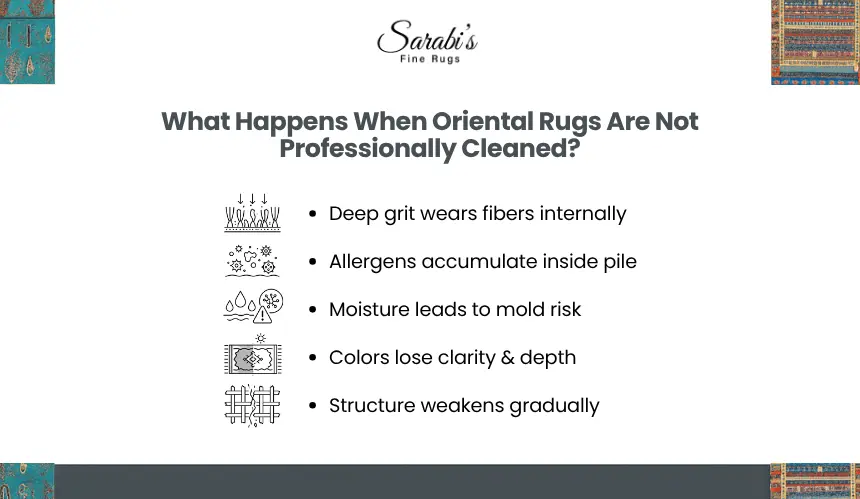
Oriental rugs do not deteriorate suddenly. Damage develops gradually through microscopic abrasion, moisture imbalance, and contaminant buildup. Because much of this process occurs beneath the visible surface, problems often remain unnoticed until structural weakening has already begun.
Deep Soil Abrasion and Fiber Breakdown
Dry soil is the primary silent threat. Research in the textile and flooring industry consistently shows that most embedded rug soil consists of dry particulate matter, including sand, skin cells, pollen, and airborne debris. In a dense hand-knotted rug, these particles migrate to the knot base, where routine vacuuming cannot fully remove them.
With daily foot traffic, this trapped grit acts like fine sandpaper. Each step grinds particles against wool fibers, gradually thinning and fraying them from the inside out.
Important Insight: Wool fibers can bend up to 20,000 times without breaking under normal conditions. However, when coated with abrasive grit, that resilience drops significantly. Fiber fatigue accelerates when dry soil is not professionally extracted.
Over time, pile height reduces, patterns lose definition, and the rug’s tactile softness diminishes.
Allergen Accumulation and Indoor Air Quality Impact
Because oriental rugs are thick and highly absorbent, they can trap airborne contaminants more effectively than low-pile synthetic carpets. These include:
- Dust mites
- Pet dander
- Mold spores
- Pollen
- Bacteria
Did you know?
The average indoor environment can contain significantly higher particulate levels than outdoor air, especially in enclosed residential spaces. Rugs act as both filters and reservoirs for these particles.
Without periodic deep washing, contaminants accumulate below the surface where they cannot be removed by standard vacuuming alone. This can contribute to allergy flare-ups and respiratory irritation, particularly in homes with pets or high humidity levels.
Moisture Retention and Mold Risk
Oriental rugs absorb moisture easily due to their organic fiber composition. Spills, pet accidents, and improper cleaning methods can allow water to penetrate deep into the foundation.
When moisture remains trapped:
- Dye migration may occur
- Cotton foundation threads may weaken
- Mold growth can develop within the backing
Critical Note: Mold does not require flooding to form. Even moderate humidity combined with organic material can create favorable conditions if drying is incomplete.
Musty odors are often a delayed sign of sub-surface microbial growth rather than surface dirt.
Foundation Distortion and Structural Stress
The warp and weft threads that hold an oriental rug together must remain balanced in tension. Soil accumulation and uneven moisture distribution can stress these threads over time.
If shrinkage occurs, the rug may:
- Develop ripples
- Curl at the edges
- Show fringe distortion
- Lose dimensional symmetry
These changes are not cosmetic. They indicate structural imbalance.
Why Is DIY Cleaning Risky for Oriental Rugs?
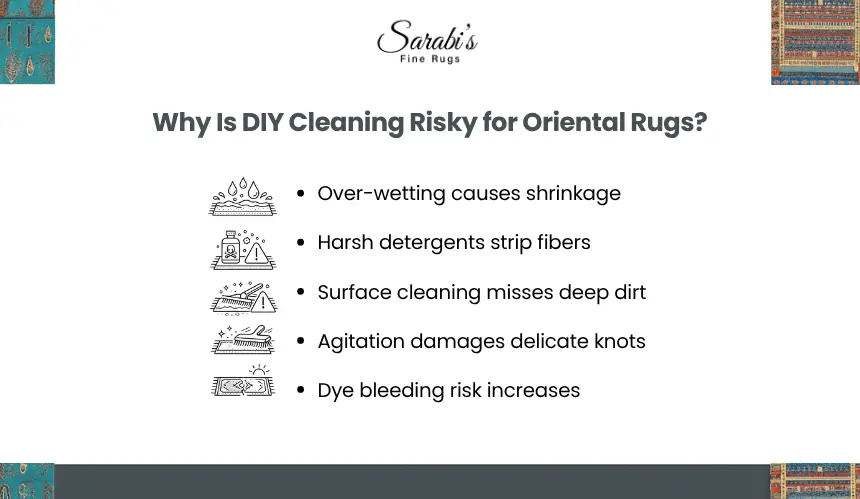
Many homeowners assume that if a product is labeled “carpet safe,” it must also be safe for oriental rugs. However, most consumer-grade carpet cleaning systems are engineered for synthetic, glued-back carpeting, not hand-knotted textiles made from natural fibers and organic dyes.
The construction difference affects how the rug reacts to water, heat, agitation, and detergents.
Over-Wetting and Prolonged Drying
Rental steam cleaners and home extraction machines inject large volumes of water under pressure. While synthetic carpet backings are designed to tolerate this saturation, oriental rugs absorb moisture deep into their wool pile and cotton foundation.
Important Fact:
Wool can absorb up to 30 percent of its weight in moisture without feeling wet to the touch. That means a rug may appear dry on the surface while the foundation remains damp underneath.
When moisture is not extracted in a controlled environment with airflow and temperature regulation, it can lead to:
- Dye migration
- Browning
- Foundation shrinkage
- Microbial growth
Professional facilities use controlled drying chambers or elevated drying racks to prevent these complications.
Harsh Detergents and pH Imbalance
Many household carpet shampoos are formulated with alkaline detergents to break down synthetic oil-based stains. Natural wool fibers, however, perform best in a slightly acidic to neutral pH environment.
When exposed to high-alkaline cleaners:
- Lanolin oils are stripped
- Fibers lose flexibility
- Texture becomes coarse
- Color vibrancy fades
Did you know?
Wool is chemically similar to human hair. Just as harsh chemical treatments damage hair protein, improper cleaners can weaken wool fibers at a structural level.
Professional cleaners test fiber type and dye stability before selecting a pH-balanced cleaning solution.
Surface Cleaning vs Deep Soil Removal
DIY methods primarily address visible stains. They rarely remove the dry soil embedded at the base of hand-tied knots.
Without specialized dusting equipment, compacted particulate matter remains trapped beneath the pile. As discussed earlier, this grit continues abrading fibers long after the surface appears clean.
Professional rug cleaning often begins with mechanical dry soil extraction before any washing occurs. This step alone can remove a substantial portion of embedded debris that vacuuming cannot reach.
Agitation and Mechanical Stress
Aggressive scrubbing, rotating brush heads, and high-speed agitation may distort fibers or fuzz delicate silk highlights. In antique rugs, even moderate friction can loosen weakened knots.
Pro Insight: Silk accent fibers are significantly less resilient than wool and can lose luster when subjected to excessive mechanical friction.
What Does Professional Oriental Rug Cleaning Involve?
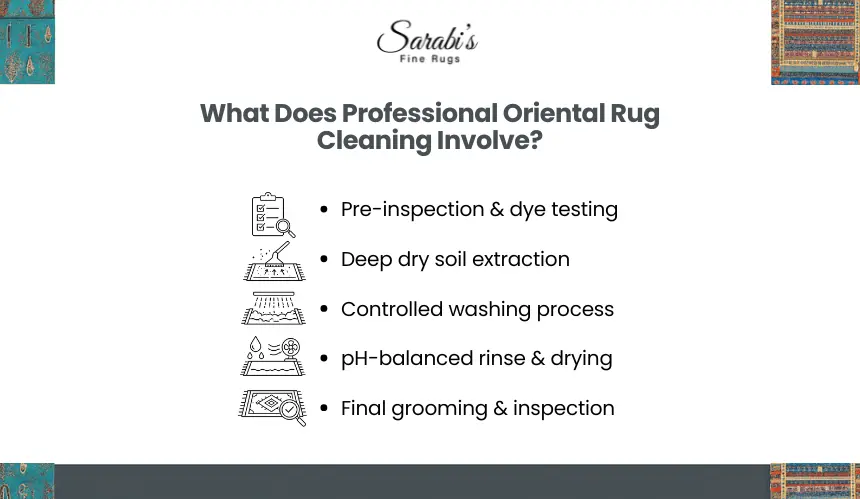
Professional oriental rug cleaning is a controlled, multi-stage process for textile preservation. It is designed not only to remove stains but to stabilize fibers, protect dyes, and restore structural balance. Unlike in-home carpet cleaning, the process is customized based on fiber type, dye composition, age, and condition.
Each step addresses a specific risk factor that DIY methods often overlook.
Pre-Inspection and Dye Stability Testing
Every rug is evaluated before cleaning begins. Technicians identify:
- Fiber composition (wool, silk, cotton foundation)
- Knot density and weave type
- Existing wear patterns
- Previous cleaning damage
- Dye stability under moisture
Dye testing is critical. A small, controlled moisture application determines whether colors are prone to bleeding. If instability is detected, stabilizing treatments are applied before washing.
Important Note:
Antique and vegetable-dyed rugs are more sensitive to pH shifts and temperature changes than modern synthetic-dyed rugs.
Advanced Dry Soil Removal
Before any water is introduced, embedded particulate soil must be extracted.
Did you know?
In many rugs, dry soil accounts for the majority of contamination by weight. If not removed first, it can turn into mud during washing and settle deeper into the foundation.
Professional facilities use specialized dusting equipment that vibrates or gently agitates the rug from beneath, releasing compacted grit from the knot base. This stage significantly reduces the risk of fiber abrasion.
Controlled Immersion Washing
Unlike steam cleaning, which injects water under pressure, professional rug cleaning often involves controlled immersion washing in a shallow wash pit or platform.
This method allows:
- Even distribution of moisture
- Gentle fiber-safe agitation
- Complete soil suspension
- Balanced pH control
Water temperature and detergent selection are carefully calibrated to protect natural dyes and protein-based fibers.
Fun Fact: Immersion washing mimics traditional rug-washing techniques used for centuries in weaving regions, where rugs were gently washed in flowing water to preserve the integrity of the dyes.
pH-Balanced Rinse and Moisture Extraction
After washing, rugs are thoroughly rinsed to remove detergent residues. Residual soap can attract soil more quickly and alter fiber chemistry.
Professional extraction systems remove excess moisture evenly across the surface. Uneven extraction can create an imbalance in the foundation’s tension.
Controlled Drying Environment
Drying is one of the most critical stages. Rugs are dried in temperature-controlled environments with regulated airflow to prevent:
- Shrinkage
- Dye migration
- Mildew formation
- Curling edges
Important Insight: Improper drying is a leading cause of post-cleaning distortion in hand-knotted rugs.
Final Grooming and Inspection
Once dry, the pile is groomed to restore uniform direction and texture. Fringe cleaning and minor foundation corrections may also be performed if needed.
A final inspection ensures:
- Color consistency
- Proper tension alignment
- Complete contaminant removal
- Structural stability
How Often Should Oriental Rugs Be Professionally Cleaned?
Cleaning frequency is not one-size-fits-all. It depends on traffic levels, environmental conditions, fiber type, and household activity. Because oriental rugs trap soil deep within their knot structure, visible dirt is often not the best indicator of internal wear.
What Is the Standard Cleaning Timeline for Most Homes?
For rugs placed in moderate-traffic areas such as formal living rooms or bedrooms, professional cleaning every 3 to 5 years is generally recommended. This timeframe allows for safe removal of embedded dry soil before fiber abrasion becomes significant.
Research within flooring maintenance studies indicates that a large percentage of rug contamination consists of fine particulate matter that is not easily visible. Even when a rug appears clean, soil may be accumulating at the knot base where friction gradually weakens fibers.
How Does High Foot Traffic Change the Timeline?
In homes with children, pets, or frequent gatherings, soil accumulation accelerates. Entryways, hallways, and family rooms experience concentrated compression and movement, which pushes grit deeper into the pile.
Under these conditions, cleaning every 2 to 3 years is often more appropriate. Delaying maintenance in high-traffic zones increases the likelihood of:
- Fiber thinning along walking lanes
- Color dullness from embedded debris
- Foundation stress from uneven compression
Rotating the rug every 6 to 12 months helps distribute wear more evenly and slows localized deterioration.
Do Pets, Allergies, or Humidity Affect Cleaning Frequency?
Yes. Organic fibers such as wool and silk absorb environmental particles and moisture more readily than synthetic carpeting.
Homes with pets may require more frequent cleaning due to:
- Dander accumulation
- Accidental moisture exposure
- Odor retention within the pile
In humid climates, retained moisture can increase the risk of microbial growth within the foundation. In dry, dusty regions, airborne particulate matter settles rapidly into dense knot structures.
For allergy-sensitive households, professional washing may provide greater contaminant reduction than vacuuming alone.
Do Antique or Silk Rugs Require Different Scheduling?
Antique and silk rugs do not necessarily need more frequent washing, but they do require closer monitoring. Because silk fibers are less resilient than wool, improper timing or cleaning methods can cause damage.
Periodic professional inspection allows assessment of:
- Dye stability
- Fiber strength
- Early signs of foundation stress
Preventive evaluation is often more valuable than reactive restoration.
Frequently Asked Questions
Can professional cleaning restore an oriental rug’s original softness?
In many cases, yes. When embedded dry soil is safely removed, and wool fibers are rinsed with pH-balanced solutions, the pile often regains flexibility and softness. However, if fiber abrasion has already occurred due to prolonged soil friction, texture improvement may be partial rather than complete.
Is steam cleaning safe for hand-knotted oriental rugs?
Steam cleaning is generally not recommended for most hand-knotted rugs. High heat and pressurized water can cause dye migration, foundation shrinkage, and uneven moisture retention. Oriental rugs respond better to controlled immersion washing with calibrated temperature and moisture management.
How long does professional oriental rug cleaning take?
The full process typically takes several days, depending on fiber type, drying requirements, and condition. Washing may be completed in a single session, but controlled drying and final inspection require additional time to ensure the foundation remains stable and moisture is fully eliminated.
Can professional cleaning remove pet urine from oriental rugs?
If addressed early, professional washing can significantly reduce urine contamination by flushing affected fibers and neutralizing residues. However, prolonged exposure may permanently affect dyes or weaken foundation threads, especially in wool or silk rugs.
Will cleaning affect the value of an antique oriental rug?
Proper professional cleaning can help preserve value by removing abrasive soil and stabilizing fibers. In contrast, improper cleaning methods may reduce value through dye bleeding, fiber distortion, or structural shrinkage. Preservation-focused cleaning supports long-term textile integrity.
How can homeowners tell when their rug needs professional cleaning?
Visible dullness, compacted pile, uneven texture, lingering odors, or increased allergy symptoms may indicate internal soil accumulation. Because much contamination settles below the surface, waiting for obvious staining is not always advisable. Periodic inspection by a rug specialist provides a more accurate assessment than visual judgment alone.
Need a handmade rug cleaned or repaired? See our rug cleaning and repairs service, with pickup and delivery available depending on your location.