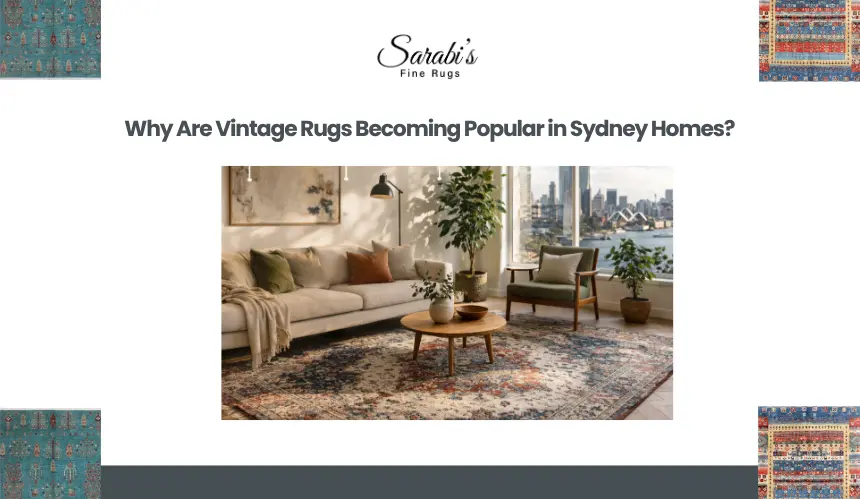
Quick Answer: Vintage rugs are becoming popular in Sydney homes for their craftsmanship, sustainability, and ability to complement both heritage and contemporary interiors. Their durability, unique character, and investment value make them attractive alternatives to mass-produced floor coverings.
Shopping for one? See our vintage rugs in Sydney at our North Willoughby showroom.
Across Sydney, interiors are evolving. In terrace homes in Surry Hills, coastal apartments in Bondi, and heritage residences in Paddington and Balmain, homeowners are moving away from uniform, showroom-style decor. Even in nearby regions such as the Northern Beaches, the Inner West, and parts of the Central Coast, there is a noticeable shift toward interiors that feel layered, storied, and personal.
In a city where architecture ranges from Federation-era homes to contemporary waterfront builds, residents are looking for design elements that bridge the past and present. Vintage rugs have emerged as one of the most distinctive solutions. Their hand-knotted craftsmanship, softened palettes, and aged textures introduce warmth into modern spaces while complementing Sydney’s architectural character.
But their rising popularity is not driven solely by aesthetics. Sustainability awareness, investment value, durability, and authenticity are all influencing purchasing decisions. Understanding why vintage rugs are becoming popular in Sydney homes reveals a broader change in how residents think about design, value, and long-term living.
What Is Driving the Rise of Vintage Rugs in Sydney Interiors?
The growing popularity of vintage rugs in Sydney homes reflects a broader transformation in interior design priorities. Across suburbs such as Paddington, Balmain, Surry Hills, and the Northern Beaches, homeowners are moving beyond mass-produced decor toward pieces that offer authenticity, longevity, and environmental responsibility. This shift is not driven solely by aesthetics. It is influenced by sustainability awareness, architectural compatibility, and investment logic.
How have Sydney’s Interior Design Trends Shifted Toward Character and Individuality?
Over the past decade, Sydney interiors have embraced minimalist design, neutral palettes, engineered timber flooring, open-plan layouts, and streamlined furniture. While clean and contemporary, these spaces can feel visually flat without textural contrast.
Vintage rugs introduce pattern layering, tonal variation, and aged patina that add depth to neutral interiors.
Did you know?
Research on interior styling shows that layered textures increase perceived warmth and comfort in living spaces. Patterned wool rugs can visually soften hard flooring surfaces and improve spatial balance in open-plan homes.
In design-forward suburbs such as Newtown and Marrickville, individuality is highly valued. Vintage Persian and Turkish rugs are unique because each piece carries subtle variations in weave, dye saturation, and wear patterns that cannot be replicated by machine production.
Why are Homeowners Moving Away From Mass-Produced Synthetic Rugs?
Mass-produced rugs are often made from polypropylene, polyester, or blended synthetic fibres. While affordable, these materials may degrade faster under heavy foot traffic and lack the density of traditional hand-knotted textiles.
Vintage rugs, particularly those made from natural wool, are woven rather than glued. This construction technique significantly enhances structural integrity.
Fun fact: A high-quality hand-knotted rug can contain anywhere from 200,000 to over 1 million individual knots, depending on size and craftsmanship. Higher knot density generally increases durability and design precision.
In heritage-heavy areas such as Glebe and Balmain, where Federation and Victorian homes are preserved, homeowners often prefer decor elements that align with architectural authenticity rather than disposable design trends.
Is Sustainability Influencing Rug Purchasing Decisions in Sydney?
Environmental awareness continues to shape consumer behaviour across Sydney and nearby coastal regions. From waste-reduction initiatives to sustainable construction practices, the emphasis on responsible consumption is expanding into interior design.
The global textile industry contributes substantially to landfill waste due to short product lifecycles. Vintage rugs support circular economy principles by extending the life of existing handcrafted textiles instead of creating demand for new manufacturing.
Did you know?
Natural wool fibres are biodegradable, renewable, and naturally flame-resistant. In contrast, synthetic fibres derived from petroleum-based materials can take decades to decompose.
Choosing a vintage rug aligns with sustainability goals while maintaining durability and aesthetic appeal.
Are Vintage Rugs Seen As Long-Term Value Pieces Rather Than Short-Term Trends?
In a property market as competitive as Sydney’s, particularly in areas such as Mosman and the Eastern Suburbs, long-term design value matters. Vintage rugs are often perceived as heirloom-quality pieces rather than seasonal decor.
Unlike trend-driven furnishings that cycle every few years, vintage rugs transcend shifting styles. They complement minimalist interiors, eclectic spaces, coastal homes, and heritage properties alike.
Pro Tip: Interior stylists frequently use vintage rugs to anchor open-plan living areas, creating defined visual zones without structural renovation.
This adaptability and longevity contribute significantly to their rising popularity.
How Do Vintage Rugs Complement Sydney’s Architectural Styles?
Sydney’s architectural landscape is diverse. From Victorian terraces in Glebe to Federation homes in Haberfield, coastal residences in Bondi, and contemporary apartments in Parramatta, each style carries its own visual language. Vintage rugs have become popular partly because they adapt seamlessly across these varied environments while enhancing architectural character rather than competing with it.
Their versatility makes them suitable for both heritage preservation and modern minimalism.
How do Vintage Rugs Enhance Federation and Victorian Terrace Homes?
Federation and Victorian homes across suburbs such as Balmain, Paddington, and Annandale often feature ornate ceilings, timber flooring, stained glass windows, and decorative fireplaces. These architectural details already carry historical depth.
Vintage Persian and Turkish rugs naturally complement these elements through intricate motifs, traditional patterns, and rich dye compositions. The craftsmanship of hand-knotted wool aligns with the artisanal details of period architecture.
Did you know? Many traditional rug patterns were originally designed to reflect regional identity, cultural symbolism, and craftsmanship, making them historically aligned with homes that value architectural storytelling.
Instead of introducing a stylistic contrast, vintage rugs reinforce the authenticity of these older homes.
Why Do Vintage Rugs Work in Sydney’s Coastal Interiors?
In coastal suburbs such as Bondi, Coogee, and the Northern Beaches, interiors typically feature lighter palettes, linen textures, and natural materials like timber and stone. These homes emphasize openness and natural light.
Vintage rugs provide a grounding contrast in these spaces. Their faded tones and worn patina soften expansive white walls and timber flooring without overwhelming the coastal aesthetic.
Pro Tip:
Rugs with muted vegetable-dye palettes tend to blend more harmoniously with coastal interiors than heavily saturated modern designs.
By adding texture and depth, vintage rugs prevent coastal spaces from feeling overly minimal or visually flat.
How Do Vintage Rugs Define Space in Modern Open-Plan Homes?
Many newer Sydney apartments and houses embrace open-plan living. While spacious, these layouts often lack clear visual separation between living, dining, and kitchen areas.
Vintage rugs act as zoning tools. A well-sized rug anchors furniture groupings and defines functional areas without adding partitions.
Fun fact: Interior design principles suggest that rugs should extend under at least the front legs of sofas and chairs in a seating area to create a cohesive layout. Proper placement enhances perceived structure within open-plan spaces.
This practical function increases their appeal in high-density urban areas such as Zetland and Waterloo.
Can Vintage Rugs Bridge Old and New Design Elements?
Sydney homes frequently combine heritage exteriors with contemporary renovations. It is common to see original brick facades paired with modern glass extensions or minimalist interiors.
Vintage rugs serve as transitional design elements in these hybrid spaces. Their aged textures soften sleek finishes, creating visual continuity between traditional and modern features.
Rather than clashing with polished concrete floors or contemporary furniture, the rug introduces warmth that balances harder materials.
Why Is Sustainability Influencing Rug Buying Decisions in Sydney?
Sustainability is no longer a niche consideration in Sydney’s housing market. From solar installations in the Inner West to recycled timber use in coastal renovations, environmentally conscious choices are shaping how homes are built, renovated, and styled. This mindset increasingly extends to soft furnishings, including rugs.
Vintage rugs are gaining popularity because they align with circular economy principles, reduce environmental impact, and prioritize longevity over short-term consumption.
How Do Vintage Rugs Support a Circular Economy?
A circular economy focuses on reuse, restoration, and extending product life rather than constant replacement. Vintage rugs embody this concept. Instead of commissioning new production, homeowners purchase existing handcrafted textiles that may already be several decades old.
Did you know?
The global textile industry has a significant environmental impact, including water consumption and landfill waste. Extending the life of existing textiles reduces demand for new manufacturing and lowers the overall environmental footprint.
By choosing a vintage rug, Sydney homeowners participate in reuse rather than contribute to fast-decor turnover cycles.
Why Are Natural Fibers More Sustainable Than Synthetic Alternatives?
Most traditional vintage rugs are made from wool, cotton, or silk. Wool, in particular, is renewable, biodegradable, and naturally resilient. It is also naturally flame-resistant and durable under heavy foot traffic.
In contrast, many modern mass-produced rugs use polypropylene or polyester derived from petroleum-based materials.
Fun fact: Wool fibres naturally repel dirt and moisture due to their structure, helping vintage wool rugs last longer even in high-traffic areas.
Natural fibre construction not only improves durability but also reduces long-term waste, as synthetic rugs degrade more quickly.
Does Durability Reduce Environmental Impact Over Time?
Longevity is one of the most important sustainability factors. A rug that lasts 50–100 years significantly reduces replacement frequency.
Did you know?
High-quality hand-knotted rugs can outlast multiple generations when properly maintained. Some 19th-century antique rugs are still in use today.
Because vintage rugs can be cleaned, restored, and even re-edged, they are repairable rather than disposable. This repairability reduces landfill contribution and supports sustainable ownership.
Are Sydney Homeowners Prioritizing Conscious Consumption?
Across suburbs such as Newtown and Marrickville, there is a visible emphasis on ethical sourcing and sustainable living. Markets, local businesses, and renovation trends reflect this awareness.
Choosing vintage textiles aligns with broader lifestyle values:
- Reduced environmental footprint
- Support for artisan craftsmanship
- Avoidance of mass-production cycles
- Investment in long-lasting goods
Vintage rugs satisfy both aesthetic and environmental priorities, making them increasingly attractive to Sydney buyers who view sustainability as integral to modern living.
Are Vintage Rugs More Durable and Valuable Over Time?
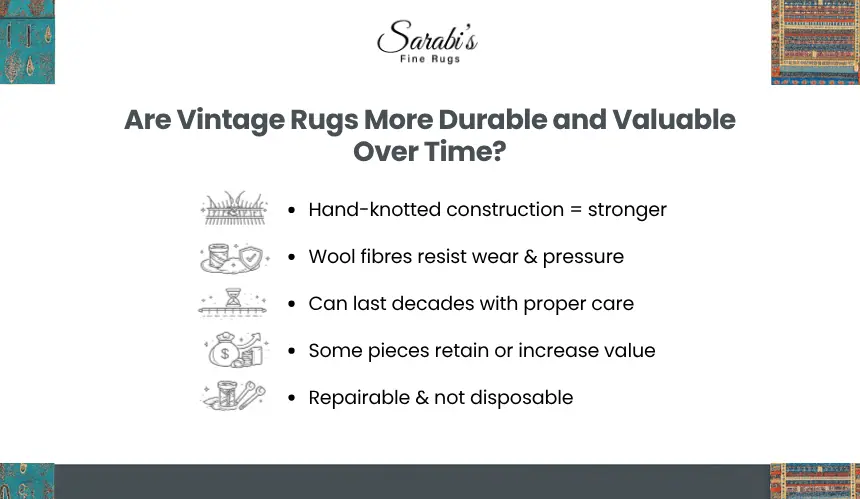
Beyond aesthetics and sustainability, durability and long-term value are major reasons vintage rugs are becoming popular in Sydney homes. In a property market where homeowners think in decades rather than seasons, furnishings are increasingly evaluated for lifespan, resilience, and investment potential.
Vintage rugs stand out because they are built differently from many modern alternatives.
How Does Hand-Knotting Increase Durability?
Traditional vintage rugs, particularly Persian, Turkish, and Afghan varieties, are hand-knotted rather than machine-woven or glued. Each knot is individually tied to the foundation, creating a dense, structurally stable textile.
Did you know? High-quality hand-knotted rugs can contain between 200,000 and over 500,000 knots per square metre. Greater knot density often correlates with higher durability and finer detail.
Unlike many machine-made rugs that rely on adhesive backing, hand-knotted rugs maintain their structure through interlocked fibres. This allows them to withstand heavy foot traffic common in busy Sydney households.
Why Does Wool Improve Long-Term Performance?
Most vintage rugs are crafted from natural wool, a fibre known for resilience and elasticity. Wool fibres naturally bounce back after compression, making them ideal for high-use living areas.
Fun fact: Wool can bend thousands of times without breaking, which is why it performs well in rugs subjected to daily foot traffic.
This resilience means that even in active homes across suburbs like Ryde or Chatswood, vintage wool rugs maintain appearance and structural integrity longer than many synthetic options.
Can Vintage Rugs Retain or Increase Value?
While not every vintage rug appreciates financially, certain pieces with high knot counts, rare patterns, or specific regional origins may retain value over time. Antique and semi-antique rugs with documented provenance are particularly sought after.
In Sydney’s high-value housing market, design elements that signal quality and craftsmanship contribute to overall property presentation. A well-maintained vintage rug can enhance the perceived sophistication of an interior.
Pro Tip: Proper care, including professional cleaning and occasional rotation, preserves fibre strength and colour balance, helping maintain both aesthetic and resale value.
How Does Longevity Compare with Modern Rugs?
Many contemporary synthetic rugs are designed for affordability and trend alignment. However, they may show wear more quickly, especially in high-traffic areas.
Vintage rugs, by contrast, are often already decades old yet remain functional and visually compelling. Their patina and slight fading are viewed as character rather than damage.
Did you know?
Some 19th-century hand-knotted rugs are still in circulation today, demonstrating the longevity of traditional weaving techniques.
This long-term performance reduces replacement frequency and reinforces their value proposition for Sydney homeowners seeking durable, timeless decor.
How Do Vintage Rugs Enhance Property Styling and Market Appeal?
In Sydney’s competitive property market, presentation influences perception. Whether in Mosman, the Eastern Suburbs, or the Inner West, homes are often styled strategically to create emotional impact. Vintage rugs have become a preferred styling element because they add depth, warmth, and perceived quality without structural renovation.
Their influence extends beyond decoration. They shape how buyers experience space.
How Do Vintage Rugs Create Visual Warmth In Neutral Interiors?
Many Sydney homes feature light timber floors, white walls, and minimalist finishes. While clean and contemporary, these interiors can appear visually cool or sparse without layered elements.
Vintage rugs introduce:
- Tonal contrast
- Pattern complexity
- Textural softness
Did you know? Design psychology research suggests that layered materials and warm textures increase perceived comfort and a sense of homeliness during property viewings.
A faded Persian or Turkish rug placed beneath a neutral sofa can immediately ground the room, reducing visual emptiness and enhancing balance.
How do Rugs Help Define Open-Plan Spaces for Staging?
Open-plan layouts are common in modern Sydney developments across areas like Zetland, Waterloo, and Rhodes. However, large uninterrupted spaces can lack clear functional boundaries.
Vintage rugs serve as visual anchors that:
- Define seating areas
- Frame dining zones
- Improve spatial proportion
Pro Tip: Interior stylists often ensure rugs extend under key furniture pieces, such as sofas and dining tables, to create cohesion and intentional design flow.
This subtle zoning enhances buyer perception of thoughtful layout planning.
Do Vintage Rugs Influence Perceived Property Value?
Buyers often associate handcrafted or heritage items with quality and permanence. A well-selected vintage rug signals intentional design choices rather than generic staging.
In suburbs such as Paddington or Balmain, where architectural character is central to property identity, incorporating vintage textiles reinforces authenticity.
Fun fact: Homes styled with layered textiles and curated decor often photograph better for online listings, improving engagement in digital property marketing.
Although a rug alone does not change structural value, it contributes to emotional resonance, a powerful factor in competitive bidding environments.
How Do Vintage Rugs Bridge Heritage and Modern Renovations?
Many Sydney properties blend old and new, preserved facades paired with contemporary interiors. Vintage rugs help visually connect these design contrasts.
Their aged patina softens:
- Polished concrete floors
- Glass extensions
- Minimalist cabinetry
Rather than clashing with modern finishes, they introduce warmth, creating continuity between historical and contemporary elements.
Are Vintage Rugs Worth the Investment for Sydney Homeowners?
As vintage rugs become more visible across Sydney interiors, many homeowners ask a practical question: are they simply aesthetic trends, or do they offer genuine long-term value? The answer lies in durability, adaptability, and lifecycle cost rather than short-term styling appeal.
In a city where property is viewed as a long-term asset, furnishings are increasingly evaluated through the same lens.
How Does Cost Compare Over a Long Lifespan?
Vintage rugs may cost more upfront than mass-produced alternatives. However, lifecycle cost often tells a different story.
A synthetic rug might need replacement within 5–10 years, depending on traffic and fibre quality. By contrast, a well-maintained hand-knotted wool rug can last 50 years or more.
Did you know? When lifespan is factored into annual cost, high-quality handmade rugs can be more economical over time than repeatedly replacing lower-cost machine-made rugs.
This durability reduces replacement frequency and long-term spending.
Do Vintage Rugs Adapt to Changing Design Styles?
Interior trends evolve. However, vintage rugs are not tied to one design movement. They pair equally well with minimalist Scandinavian furniture, coastal Australian interiors, and traditional timber homes.
Their muted palettes and aged finishes allow them to integrate into evolving layouts without appearing outdated.
Pro Tip: Neutral-toned vintage rugs with subtle pattern fading tend to offer the greatest styling flexibility across multiple renovation phases.
This adaptability makes them resilient purchases rather than seasonal decor choices.
Can Maintenance Protect Long-Term Value?
Proper care significantly extends the lifespan of natural fibre rugs. Regular vacuuming, rotation, and professional cleaning preserve knot structure and colour integrity.
Unlike many synthetic rugs that deteriorate beyond repair, vintage wool rugs can often be restored, re-edged, or professionally repaired.
Fun fact: Traditional rug restoration techniques can rebuild worn edges and reinforce foundations, extending the usable life by decades.
This repairability enhances both sustainability and financial value.
Do Vintage Rugs Contribute to Long-Term Home Appeal?
In Sydney’s premium suburbs, quality materials and curated interiors often influence buyer perception. Even if not sold with the property, vintage rugs elevate the quality of daily living and the interior experience.
Their craftsmanship, cultural heritage, and tactile comfort contribute to a sense of permanence, an important factor in homes designed for long-term ownership.
Frequently Asked Questions
Why are vintage rugs trending in Sydney specifically?
Sydney’s mix of heritage architecture, coastal interiors, and modern open-plan homes creates strong demand for layered, character-rich decor. Vintage rugs complement Federation terraces, waterfront apartments, and contemporary renovations alike, making them adaptable across the city’s diverse housing styles.
Are vintage rugs suitable for high-traffic households in Sydney?
Yes, particularly hand-knotted wool rugs. Traditional weaving techniques interlock fibres tightly, improving durability. Wool’s natural elasticity helps it recover from compression, making vintage rugs well-suited for living rooms, hallways, and family spaces with regular foot traffic.
How can you tell if a vintage rug is high quality?
Quality indicators include knot density, material composition (natural wool or silk), clear pattern definition, and strong foundation integrity. Hand-knotted rugs typically display slight irregularities on the back, while machine-made rugs often have uniform backing and visible stitching lines.
Do vintage rugs require special maintenance?
Routine vacuuming without aggressive brush heads, occasional rotation to balance wear, and professional cleaning every few years are generally sufficient. Unlike many synthetic rugs, vintage wool rugs can often be restored or repaired if edges or fibres show wear.
Are vintage rugs environmentally friendly?
Vintage rugs support sustainable consumption by extending the life of existing textiles rather than requiring new manufacturing. Most are made from biodegradable natural fibres such as wool and cotton, reducing long-term environmental impact compared to petroleum-based synthetic alternatives.
Can vintage rugs increase a home’s resale appeal?
While rugs are not structural upgrades, they enhance interior presentation. In competitive Sydney property markets, layered styling and quality materials can influence buyer perception and improve visual impact during inspections and online listings.
Looking for the real thing? Browse our vintage rugs, see them at our North Willoughby showroom, or book an in-home viewing.