Quick Answer:
Shopping for one? See our vintage rugs in Sydney at our North Willoughby showroom.
Check the age classification: a true vintage rug is typically 20–100 years old, while an antique rug is over 100 years old.
Inspect the back for hand-knotting: Authentic vintage rugs show visible, irregular knots on the underside rather than a uniform stitched backing.
Look for integrated fringe: In genuine handmade rugs, the fringe is part of the foundation (warp threads), not sewn or glued on separately.
Examine material quality: Most authentic vintage rugs are made from natural wool, silk, or cotton rather than synthetic fibers.
Identify natural dye variation (abrash): Subtle colour shifts within the same shade indicate vegetable dye use, not artificial printing.
Assess wear consistency: Genuine aging shows gradual, even patina and fibre softening rather than perfectly uniform distressing.
Verify provenance when possible: Reputable sellers provide origin details such as Persian, Turkish, or Afghan weaving traditions.
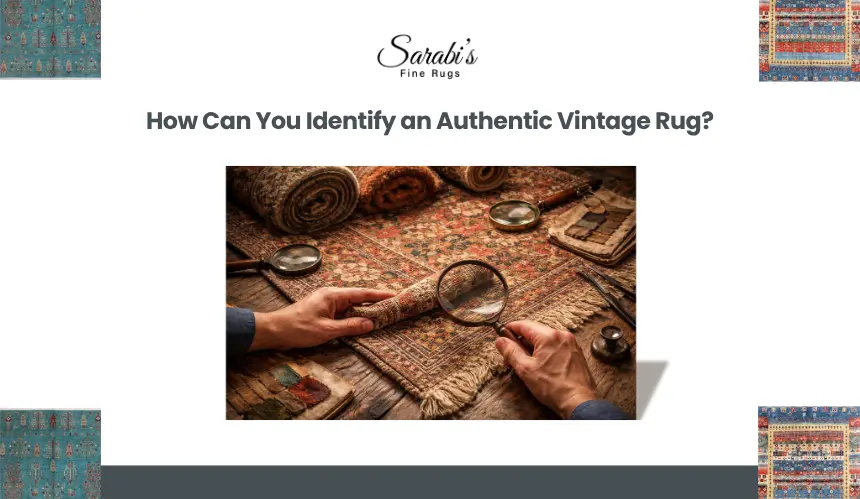
Vintage rugs are widely admired for their character, craftsmanship, and timeless appeal. However, as demand has grown, so has the number of reproductions, artificially distressed pieces, and machine-made replicas marketed as “vintage.” For buyers, collectors, and homeowners, the challenge is no longer finding a rug that looks old. It is determining whether it truly is.
An authentic vintage rug is more than faded colours and worn edges. Its value lies in hand-knotted construction, natural fibres, traditional dye techniques, and consistent signs of genuine aging. Without knowing what to inspect, from knot density to fringe integration, it is easy to mistake a modern imitation for a heritage textile.
Understanding how to identify an authentic vintage rug requires examining age classification, weaving structure, material composition, dye characteristics, and wear patterns. By learning what distinguishes handmade craftsmanship from mass-produced replicas, buyers can make informed decisions and avoid costly mistakes.
What Qualifies as a Vintage Rug?
Before examining construction or materials, it is important to define what “vintage” actually means. Many rugs are marketed as vintage solely on the basis of style or artificial distressing. However, authenticity begins with age classification and historical context.
A rug cannot be considered vintage simply because it looks old. It must meet recognized age and craftsmanship criteria.
How Old Must a Rug Be to Be Considered Vintage?
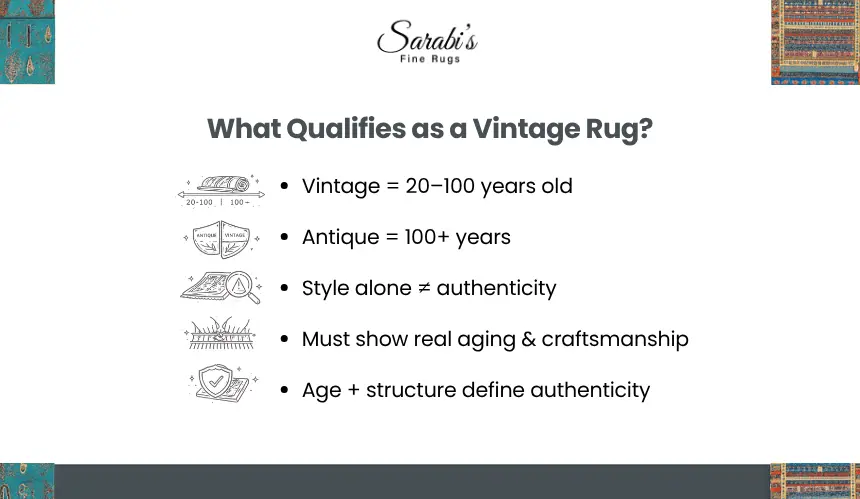
In the rug industry, a vintage rug is generally defined as 20 to 100 years old. Rugs older than 100 years are classified as antiques. Pieces between roughly 50 and 100 years are sometimes referred to as semi-antique.
This age range reflects textiles that have developed natural patina and wear but are not yet classified as antiques.
Did you know?
The term “vintage” originally referred to wine production years and later expanded into fashion and textiles to describe items from a specific era that retain quality and relevance.
Age alone does not determine authenticity, but it establishes the foundation for further inspection.
What Is the Difference Between Vintage and Antique Rugs?
While both categories involve handmade craftsmanship, the distinction is primarily chronological.
- Vintage rugs: 20–100 years old
- Antique rugs: Over 100 years old
- Modern handmade rugs: Newly produced but hand-knotted
Antique rugs often display more pronounced oxidation, fibre softening, and historical dye characteristics. Vintage rugs typically retain stronger structural integrity while still showing natural aging.
Understanding this classification helps buyers evaluate price expectations and market positioning. A rug marketed as antique but only 30 years old should immediately raise concerns.
Can Style Alone Determine If a Rug Is Vintage?
No. Many modern manufacturers replicate traditional Persian, Turkish, or Afghan patterns. While stylistically similar, these rugs are newly produced.
Authenticity requires examining:
- Construction method
- Material composition
- Dye characteristics
- Signs of aging
Pattern alone is not proof of age.
How Can You Tell If a Rug Is Hand-Knotted?
One of the most reliable ways to identify an authentic vintage rug is by examining its construction. Traditional vintage rugs are typically hand-knotted, a labor-intensive weaving method that distinguishes them from machine-made or hand-tufted imitations.
Construction reveals more about authenticity than surface appearance.
Why Does Knot Density Matter?
Hand-knotted rugs are created by individually tying knots around the warp threads on a loom. The number of knots per square inch (KPSI) or per square metre indicates the rug’s density and craftsmanship level.
Higher knot density often means:
- Greater durability
- Finer design detail
- Stronger structural integrity
Did you know? Some high-quality Persian and Tabriz rugs can contain over 300,000 knots per square metre, reflecting months or even years of manual craftsmanship.
Machine-made rugs, by contrast, use power looms that produce uniform stitching patterns without individually tied knots.
How Can You Inspect the Back of the Rug?
Turn the rug over and examine the underside. In an authentic hand-knotted rug:
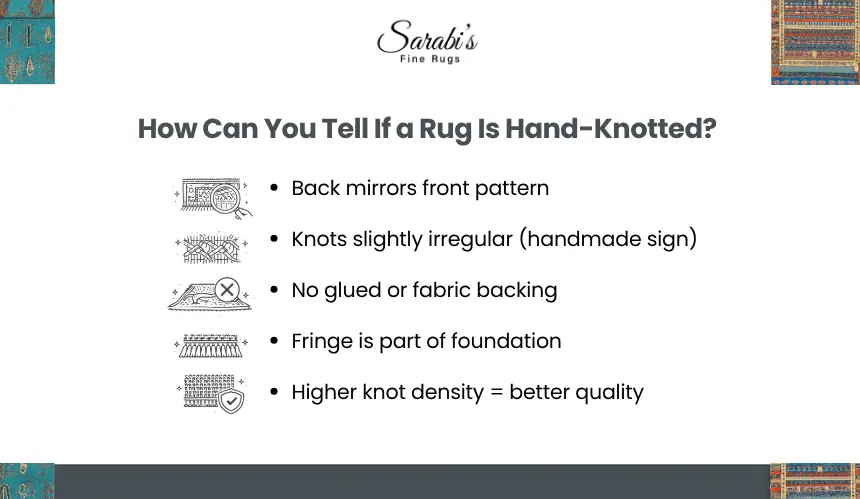
- The pattern on the back mirrors the front
- Knots appear slightly irregular
- The weave shows visible warp and weft threads
Irregularity is a positive sign. Handmade rugs are not perfectly uniform because each knot is tied manually.
Machine-made rugs often display:
- A stiff backing
- Perfectly even stitching
- Fabric or latex layers attached to the underside
If the back looks overly uniform or contains glued fabric layers, the rug is likely not hand-knotted.
Why Does Integrated Fringe Indicate Authenticity?
In genuine hand-knotted rugs, the fringe is an extension of the rug’s foundation. The fringe consists of warp threads that run through the entire structure of the rug.
In many modern replicas:
- The fringe is sewn on after production
- The fringe appears thicker or stitched separately
- Glue may be visible at the edge
Pro Tip: Gently lift the fringe. If it appears stitched or attached separately, the rug is likely machine-made or hand-tufted rather than hand-knotted.
How Does Hand-tufted Construction Differ?
Hand-tufted rugs are often mistaken for hand-knotted pieces. They are created using a tufting gun that punches yarn into a backing material. While partially handmade, they lack individually tied knots.
Hand-tufted rugs typically:
- Have a fabric backing glued to the underside
- Shed more over time
- Have shorter lifespans compared to hand-knotted rugs
Understanding this distinction prevents misclassification.
How Do Materials Reveal Authenticity?
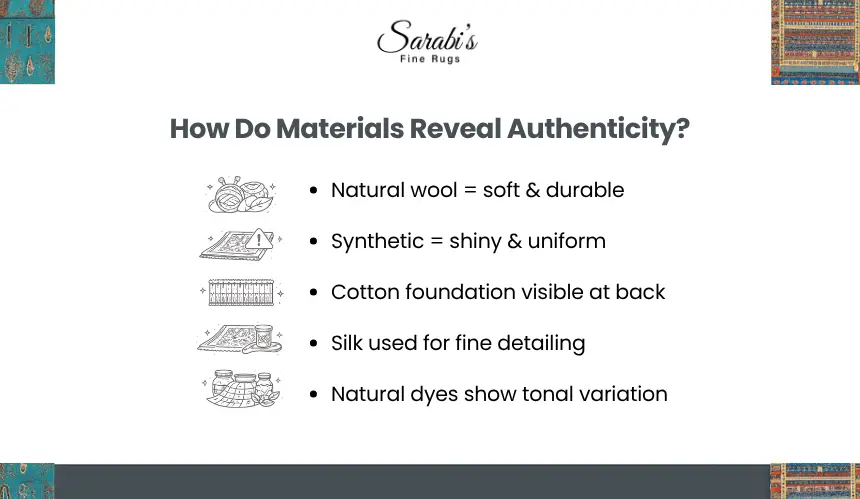
Material composition is one of the clearest indicators of whether a rug is truly vintage. Authentic vintage rugs were traditionally woven using natural fibers and dyes available in their region of origin. Modern replicas often substitute synthetic materials that alter texture, durability, and aging patterns.
Examining fiber type, foundation structure, and dye composition provides strong evidence of authenticity.
Is the Pile Made From Natural Wool?
Most authentic vintage rugs are made from wool, particularly hand-spun wool sourced from sheep in regions such as Iran, Turkey, or Afghanistan. Hand-spun wool has subtle texture variation and depth, whereas machine-spun synthetic fibers feel more uniform.
Natural wool characteristics include:
- Slightly uneven fiber thickness
- Soft but resilient texture
- Matte finish rather than glossy shine
Did you know?
Wool contains natural lanolin, which helps repel dirt and moisture. This is one reason many vintage wool rugs remain structurally strong even after decades of use.
If the rug feels overly slick or plasticky, it may contain synthetic fibers.
How Can You Test for Synthetic Fibers?
Synthetic materials such as polypropylene or polyester are common in modern reproductions. While laboratory testing is the most precise method, basic inspection can reveal clues.
Indicators of synthetic fibers include:
- Excessively bright, uniform colouring
- Plastic-like sheen
- Perfectly consistent fibre thickness
- Lower flexibility in older-looking rugs
Natural wool tends to develop soft patina and slight tonal variation over time. Synthetic fibers often exhibit flat colour consistency, lacking depth.
Does the Rug Have a Cotton Foundation?
Authentic vintage rugs often use cotton as the foundation, consisting of warp (vertical threads) and weft (horizontal threads). Cotton foundations provide structural stability and are visible when inspecting the back.
When you flip the rug:
- Look for visible white or beige cotton threads
- Check that knots are tied around foundation threads
- Ensure the pattern is clearly visible from the back
If the underside is covered with latex or cloth backing, the rug is likely hand-tufted or machine-made rather than traditionally hand-knotted.
Are There Silk Highlights Or Detailing?
Some vintage rugs incorporate silk to enhance detailing or add sheen to specific motifs. Silk highlights are typically found in high-quality Persian rugs and certain Turkish pieces.
Silk characteristics include:
- Subtle natural sheen
- Fine, delicate texture
- High knot precision in detailed areas
Fun fact: Silk was traditionally used to emphasize floral or medallion details in luxury rugs because it reflects light differently than wool.
However, entirely silk rugs require extra scrutiny, as modern reproductions sometimes imitate silk’s appearance with synthetic fibers.
Can Dye Composition Reveal Authenticity?
Vintage rugs commonly use vegetable or natural dyes derived from plants, roots, insects, and minerals. These dyes age differently from chemical alternatives.
Natural dye indicators include:
- Subtle colour variation within the same shade (known as abrash)
- Gradual fading rather than harsh colour breaks
- Soft tonal transitions
Synthetic dyes often produce:
- Overly saturated tones
- Uniform colour consistency
- Bleeding when exposed to moisture
Did you know?
Abrash occurs when natural dyes absorb unevenly during traditional dyeing processes, creating subtle shade variations considered desirable in authentic rugs.
H3: Does the Rug Show Fibre aging consistent with its claimed age?
Authentic vintage rugs develop patina over time. This includes:
- Softening of wool fibers
- Slight dulling of colour intensity
- Gradual wear in high-contact areas
Artificially distressed rugs often mimic aging through sanding or chemical treatments. However, artificial wear typically appears uniform rather than naturally distributed.
In genuine vintage rugs, wear patterns correspond logically to foot-traffic zones rather than to random areas.
How Can You Identify Natural Vegetable Dyes and Genuine Aging?
Dye composition and aging patterns are among the most revealing indicators of an authentic vintage rug. While modern reproductions can imitate traditional patterns, replicating decades of natural dye fading and fibre oxidation is far more difficult. Careful observation of colour transitions, tonal depth, and wear consistency helps distinguish genuine age from artificial distressing.
What is Abrash and Why Is It Important?
Abrash refers to subtle colour variation within the same dye field of a rug. It occurs naturally when hand-dyed yarn batches absorb vegetable dyes slightly differently. In traditional weaving, yarn was often dyed in small quantities, leading to minor tonal shifts when new batches were introduced during weaving.
Characteristics of authentic abrash include:
- Gradual transitions between shades
- Slight tonal movement within a single colour area
- Organic blending rather than sharp lines
Did you know? In authentic handwoven rugs, abrash is often considered a mark of craftsmanship rather than a flaw. Collectors value these variations because they confirm manual dyeing and weaving processes.
Machine-made rugs typically lack abrash because synthetic dyes are engineered for uniform consistency.
How Do Natural Vegetable Dyes Age Over Time?
Vegetable dyes derived from plants, roots, minerals, and insects age gracefully. Instead of fading abruptly, they soften and mellow over decades. Reds derived from madder root, blues from indigo, and yellows from pomegranate rind tend to shift into warmer, muted tones.
Authentic aging shows:
- Gentle colour softening
- Balanced fading across exposed areas
- Harmonious blending of hues
In contrast, synthetic dyes may:
- Fade unevenly
- Bleeds when exposed to moisture
- Retain overly saturated brightness inconsistent with claimed age
Fun fact: Natural indigo dyes oxidize when exposed to air, which can slightly deepen or soften blue tones over time rather than producing flat fading.
How Can You Detect Artificial Distressing?
With rising demand for vintage aesthetics, some manufacturers artificially age rugs using chemical washes, sanding, or mechanical abrasion.
Signs of artificial distressing include:
- Perfectly uniform fading across the entire surface
- Harsh colour stripping without fibre softening
- Random wear is not aligned with logical foot-traffic zones
- Strong chemical odour
Authentic vintage wear develops gradually in high-contact areas, such as entry points, central medallions, and walking paths. Edges and fringe typically show consistent aging that matches overall fibre condition.
What Role Does Fibre Patina Play in Authentication?
Patina refers to the soft sheen and texture that develops in natural fibres over time. Wool fibres become smoother and slightly compressed with decades of use. This aging process cannot be convincingly replicated through artificial treatment.
Indicators of genuine patina include:
- Fibre softness without structural weakness
- Slight dulling rather than colour stripping
- Gradual oxidation in lighter tones
Artificially aged rugs may appear faded but lack the tactile softness associated with long-term use.
Does Dye Penetration Reveal Authenticity?
In authentic hand-dyed yarn, colour penetrates through the entire fibre rather than sitting only on the surface. When fibres are examined closely, natural dye coloration remains consistent within the strand.
Surface-printed or chemically treated rugs may show colour concentrated on outer fibres while inner strands appear lighter.
Pro Tip:
Examine small fibre strands in less visible areas. If colour appears superficial rather than integrated, the rug may not be naturally dyed.
What Are Common Red Flags of Fake Vintage Rugs?
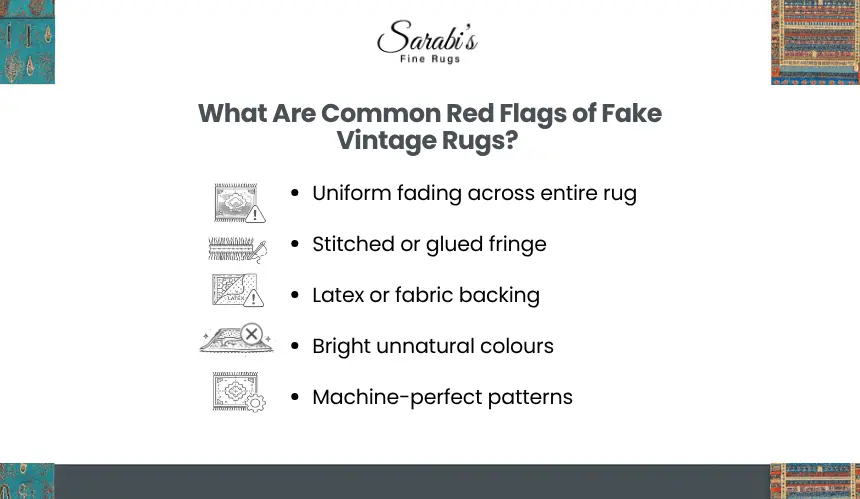
As demand for authentic vintage rugs has increased, so has the production of replicas designed to imitate age and craftsmanship. While some reproductions are marketed transparently, others are presented as genuine vintage pieces. Identifying red flags helps buyers avoid overpaying for rugs that lack historical authenticity and traditional construction.
Careful structural and material inspection is essential.
Perfectly Uniform Fading Across The Entire Surface
Authentic vintage rugs age gradually and unevenly based on foot traffic, sunlight exposure, and fibre wear. High-traffic zones typically show more compression and colour softening than peripheral areas.
When fading appears perfectly consistent across the entire rug, it may indicate artificial chemical washing or mechanical distressing.
Did You Know?
Natural aging rarely affects every part of a rug equally. Areas beneath furniture or away from walkways usually retain deeper colour tones.
Uniform fading without logical wear patterns is a strong warning sign.
Glued Or Sewn-On Fringe Instead Of Integrated Foundation
In genuine hand-knotted rugs, the fringe is part of the rug’s warp threads. These threads run through the entire structure of the rug.
Red flags include:
- Fringe stitched separately onto the edge
- Visible glue or fabric reinforcement
- Thick decorative fringe that does not align with knot foundation
Integrated fringe is one of the most reliable authenticity indicators.
Latex Or Fabric Backing On The Underside
Traditional hand-knotted rugs do not require glued backings. Their structural integrity comes from interlocked knots tied around warp and weft threads.
If the rug’s underside contains:
- Latex coating
- Fabric lining
- Synthetic mesh support
It is likely hand-tufted or machine-made rather than authentically hand-knotted.
Excessively Bright Or Chemically Saturated Colours
Authentic vintage rugs typically display muted tones due to natural dye aging and fibre oxidation. Extremely bright, uniform colours may signal modern synthetic dye use.
Artificially aged rugs sometimes undergo chemical bleaching to create a faded look. However, this process can strip colour harshly rather than gradually softening it.
Pro Tip:
Compare areas of wear with protected sections beneath the fringe. In authentic rugs, colour transitions remain harmonious rather than sharply contrasting.
Machine-Perfect Symmetry And Uniform Knotting
Handmade rugs contain subtle irregularities in knot alignment and pattern spacing. These minor variations reflect manual craftsmanship.
Machine-made rugs often display:
- Perfectly straight pattern repetition
- Identical knot formation
- Uniform stitching tension
Slight asymmetry in pattern detail is often a positive sign of hand-knotting rather than a flaw.
Artificial Chemical Odor Or Excessive Residue
Some reproduction rugs are chemically treated to accelerate aging effects. Strong chemical smells or powdery residue may indicate recent artificial distressing.
Authentic vintage rugs typically carry a neutral scent associated with natural wool and age, not chemical processing.
Unrealistically Low Pricing For Claimed Age
While price alone does not determine authenticity, extremely low prices for rugs claimed to be antique or high-density vintage pieces should prompt careful inspection.
Authentic vintage rugs require months of labour and high-quality materials. Pricing that seems disproportionately low compared to craftsmanship claims is often a red flag.
Should You Rely On Certification, Provenance, And Seller Transparency?
Beyond physical inspection, documentation and seller credibility play an important role in verifying authenticity. While structural analysis reveals craftsmanship, provenance and transparency strengthen confidence in a rug’s origin and age classification.
Authenticity is best confirmed through a combination of material inspection and reliable sourcing.
What Is Provenance And Why Does It Matter?
Provenance refers to a rug’s documented history, including its region of origin, weaving tradition, and estimated production period. Authentic vintage rugs are often associated with specific regions known for distinctive patterns and weaving techniques.
Examples include:
- Tabriz and Heriz rugs from Iran
- Oushak rugs from Turkey
- Afghan tribal rugs
- Anatolian kilims
Regional characteristics often include specific motifs, colour palettes, and knotting styles.
Did You Know?
Certain regions are known for particular knot types. For example, Persian rugs often use the asymmetrical (Senneh) knot, while many Turkish rugs use the symmetrical (Ghiordes) knot.
Understanding regional weaving traditions can help validate authenticity claims.
Can Certificates Of Authenticity Be Trusted?
Some reputable dealers provide certificates detailing age range, material composition, and origin. While certificates can add credibility, they should not replace physical inspection.
Buyers should ensure that documentation includes:
- Clear age classification (vintage vs antique)
- Region of origin
- Material details
- Knot density or construction type
Certificates from established rug dealers or professional appraisers carry more weight than generic printed statements.
How Important Is Dealer Reputation?
Seller transparency is critical when purchasing vintage rugs. Reputable dealers typically:
- Provide detailed descriptions
- Allow close inspection
- Offer return policies
- Share restoration history if applicable
In contrast, vague descriptions or reluctance to disclose origin details should raise caution.
Pro Tip: Ask direct questions about weaving technique, fibre content, and estimated age. Knowledgeable sellers can explain construction characteristics confidently.
When Should You Seek Professional Appraisal?
For high-value purchases or rugs claimed to be antique, professional appraisal may be advisable. Experienced appraisers examine knot density, dye composition, structural condition, and regional design indicators.
Appraisals are particularly useful when:
- Purchasing investment-grade rugs
- Insuring high-value pieces
- Verifying century-old antique claims
Frequently Asked Questions
How old does a rug need to be to qualify as vintage?
A rug is generally considered vintage if it is between 20 and 100 years old. Rugs older than 100 years are classified as antique. Age classification should align with construction methods, materials, and natural wear patterns rather than appearance alone.
How can I quickly check if a rug is hand-knotted?
Turn the rug over and inspect the back. Authentic hand-knotted rugs show visible individual knots and a mirrored version of the front pattern. Slight irregularities in knot spacing are normal. Latex backing or perfectly uniform stitching usually indicates machine-made or hand-tufted construction.
What is abrash, and why is it important in vintage rugs?
Abrash refers to subtle colour variation within the same dye field caused by natural dyeing techniques. It appears as gentle tonal shifts rather than sharp colour changes. Abrash is often a positive sign of handmade craftsmanship and vegetable dye use.
Are synthetic fibres always a sign that a rug is not authentic?
Most authentic vintage rugs are made from natural wool, silk, or cotton. Synthetic fibres such as polypropylene or polyester are common in modern reproductions. While some later 20th-century rugs may contain blends, heavy synthetic content often indicates a newer production.
Does fringe determine whether a rug is authentic?
Yes, fringe can be a strong indicator. In genuine hand-knotted rugs, fringe is part of the rug’s foundation (warp threads). If the fringe appears sewn or glued onto the edge, the rug is likely not traditionally hand-knotted.
Can a vintage rug be restored without losing value?
Yes. Professional restoration, including re-edging or reinforcing worn areas, can extend a rug’s lifespan without diminishing value when done correctly. However, excessive modification or chemical distressing may reduce authenticity and market appeal.
Is professional appraisal necessary before purchasing a vintage rug?
Appraisal is recommended for high-value or antique rugs, particularly those claimed to be over 100 years old. A qualified appraiser can assess knot density, dye composition, region of origin, and structural integrity to confirm authenticity and valuation.
Looking for the real thing? Browse our vintage rugs, see them at our North Willoughby showroom, or book an in-home viewing.