
Quick Answer:
Measure your seating area first, not just the room dimensions. The rug should relate to the furniture layout.
Anchor your furniture properly at a minimum; the front legs of sofas and chairs should sit on the rug to create cohesion.
Allow approximately 30–45 cm (12–18 inches) of wall clearance between the rug edge and the walls for balanced framing.
Choose larger over smaller when unsure; a slightly oversized rug usually makes a room feel more spacious and unified.
Account for traffic flow, maintain at least 60–75 cm of clear walkway space to preserve movement and door function.
Choosing the right rug size for your living room is one of the most influential and most misunderstood design decisions. Many homeowners focus on colour and pattern first, only to realise later that the rug feels disconnected, undersized, or visually awkward. In reality, size determines whether a living room feels cohesive and proportionate or fragmented and cramped.
A rug does more than sit beneath a coffee table. It anchors furniture, defines conversation zones, guides traffic flow, and shapes how spacious a room appears. Interior designers consistently identify undersized rugs as one of the most common layout mistakes because small rugs break visual continuity and make furniture appear to float.
The correct rug size should align with your seating footprint, maintain balanced wall clearance, and support natural movement through the room. Understanding measurement principles, layout rules, and spatial psychology ensures your rug enhances comfort, proportion, and visual harmony rather than disrupting them.
Why Does Rug Size Matter In A Living Room?
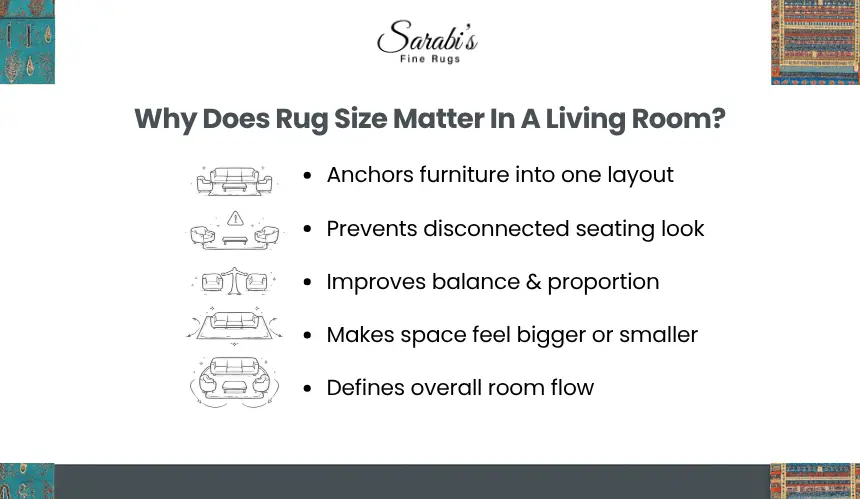
Rug size directly influences how your living room feels, functions, and flows. It determines whether furniture appears connected or scattered, whether the room feels spacious or compressed, and whether the layout looks intentional or accidental. While colour and pattern affect style, size controls structure.
In design terms, a rug acts as a visual foundation. If the foundation is misproportioned, everything placed on top of it feels misaligned.
How Does Rug Size Affect Proportion And Visual Balance?
Proportion is the relationship between objects within a space. A rug should be proportionate to the scale of your sofa, chairs, and coffee table, and to the overall room dimensions.
When a rug is too small:
- Furniture appears disconnected
- The room feels fragmented
- Visual balance is disrupted
When a rug is appropriately sized:
- Furniture feels anchored
- The seating area appears unified
- The room gains structural clarity
Did You Know? Interior design guidelines commonly recommend leaving 30–45 cm (12–18 inches) of exposed floor between the rug edge and walls to create visual framing. This border prevents the rug from looking like wall-to-wall carpet and maintains proportional harmony.
How Do Rugs Define Seating Zones?
A rug visually defines the “conversation area” within a living room. Even in enclosed rooms, it establishes a clear seating boundary. In open-plan layouts, this zoning effect becomes even more critical.
A properly sized rug:
- Connects sofas and chairs into one cohesive group
- Centers the coffee table within the seating arrangement
- Creates intentional structure
Without adequate rug coverage, furniture can appear to float independently, weakening the sense of cohesion.
Can Rug Size Change How Spacious A Room Feels?
Yes. Contrary to common belief, a larger rug often makes a room feel bigger. Small rugs break the floor into smaller visual sections, which can make a space feel crowded.
Larger rugs create:
- Continuous visual surface
- Stronger horizontal flow
- Expanded spatial perception
Design Insight: Continuous flooring surfaces visually elongate rooms, while interrupted surfaces reduce perceived scale. Choosing a slightly larger rug often improves openness rather than overwhelming the space.
How Does Rug Placement Influence Comfort And Function?
Beyond aesthetics, size affects functionality. A rug that does not extend under seating can cause uneven surfaces when people shift positions. Proper sizing ensures stability and comfort underfoot.
Additionally, adequate rug coverage:
- Reduces floor noise
- Enhances acoustic softness
- Improves overall comfort in high-use areas
How Do You Measure Your Living Room Correctly?
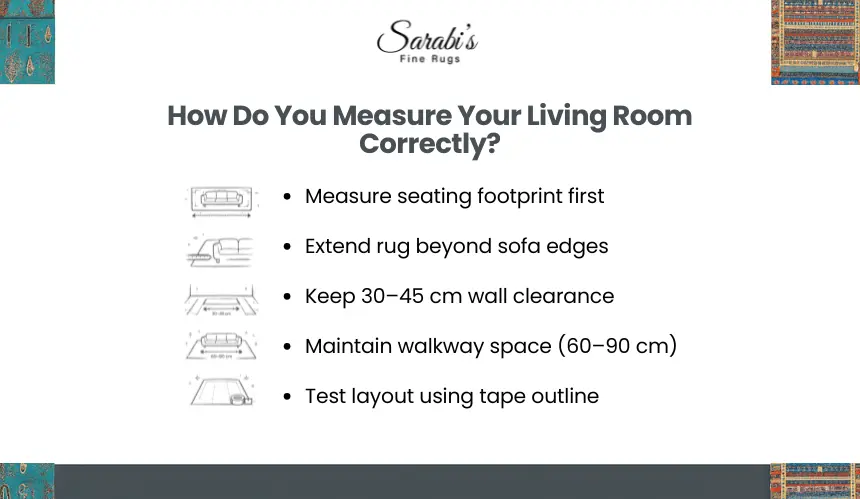
Accurate measurement is the foundation of choosing the right rug size. Many sizing mistakes occur because homeowners measure wall-to-wall dimensions instead of the actual seating footprint. A rug should relate to furniture boundaries and traffic flow, not just the room’s perimeter.
Taking precise measurements ensures proportion, comfort, and layout cohesion.
Step 1: Measure The Seating Area, Not Just The Room
Start by identifying the outer edges of your furniture arrangement.
Measure:
- The full width of your sofa
- The distance between chairs
- The depth of the seating layout
- The space occupied by a sectional
The rug should extend beyond the seating footprint to anchor the arrangement. As a general rule:
- Extend at least 15–30 cm (6–12 inches) beyond the sides of sofas and chairs.
This prevents furniture from appearing to be perched on the rug’s edge.
Step 2: Maintain Proper Wall Clearance
Wall clearance preserves visual framing and proportion. Without it, the rug may look like fitted carpet rather than a distinct design element.
Recommended clearance guidelines:
- Small rooms: 20–30 cm from walls
- Medium rooms: 30–45 cm
- Large rooms: 45–60 cm
Did You Know? Balanced border spacing creates a “frame effect” that enhances symmetry and prevents visual crowding.
Leaving too little space makes the rug overpower the floor, while excessive clearance can make the rug appear undersized.
Step 3: Account For Walkways And Traffic Flow
Traffic patterns are essential when sizing a rug. Living rooms should allow comfortable movement without stepping awkwardly on and off rug edges.
Ideal walkway clearance:
- Minimum 60 cm (24 inches)
- 75–90 cm (30–36 inches) for high-traffic zones
Avoid placing rug edges directly in heavy traffic areas, as this increases wear and creates tripping hazards.
Step 4: Test The Size Before Buying
One effective method is to outline the intended rug size on the floor using painter’s tape or newspaper. This allows you to visually confirm the scale before committing.
This technique helps you:
- Evaluate furniture anchoring
- Check border spacing
- Confirm door clearance
- Visualize the overall proportion
Pro Tip:
Photograph the taped outline from different angles. Images often reveal proportion imbalances that are less obvious in person.
Step 5: Consider Ceiling Height And Room Volume
While often overlooked, ceiling height influences perceived proportion. Taller ceilings can visually support larger rugs by expanding the vertical volume.
In rooms with:
- High ceilings → Larger rugs enhance grounding
- Lower ceilings → Moderate rug size prevents compression
Balancing floor coverage with room volume maintains design harmony.
What Are The Standard Rug Sizes For Living Rooms?
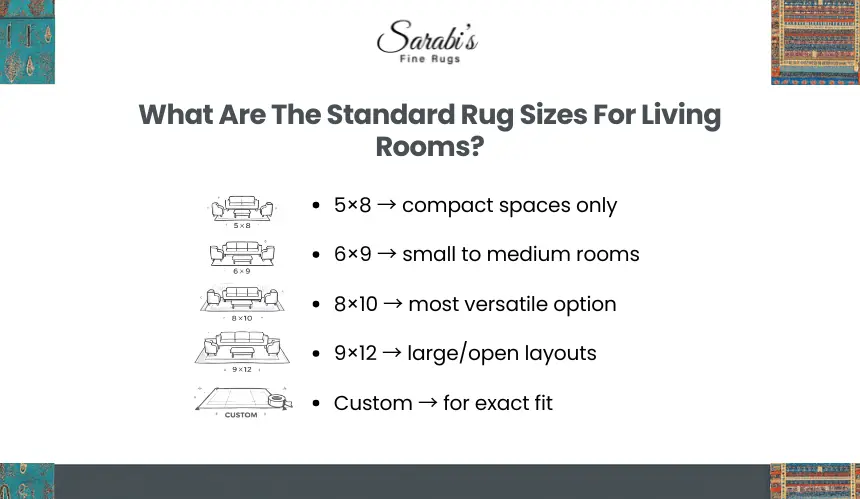
While every living room has unique proportions, most layouts fall within a few standard rug dimensions. Understanding how each size functions helps you choose based on furniture configuration rather than guesswork.
Standard sizing works best when aligned with seating footprint and border clearance guidelines.
5×8 Rugs; Suitable For Compact Spaces
A 5×8 rug is typically appropriate for:
- Studio apartments
- Small living rooms
- Minimal seating arrangements
- Coffee-table-centered layouts
In this configuration, the rug may sit beneath the coffee table with surrounding furniture placed just off the edges.
Limitation: A 5×8 rug is often too small for full living room sets. It can make sofas appear disconnected if the legs are entirely off the rug.
Best used when space is limited, and the layout is intentionally compact.
6×9 Rugs; Transitional Option For Small To Medium Rooms
A 6×9 rug provides more flexibility and can accommodate:
- Loveseat + two chairs
- Smaller three-seater sofas
- Partial front-leg placement
This size often works well when:
- The seating area is under 3 metres wide
- You want at least the front legs of the furniture on the rug
It offers improved anchoring compared to 5×8 without overwhelming smaller rooms.
8×10 Rugs; The Most Versatile Living Room Size
The 8×10 rug is considered the most commonly recommended size for standard living rooms.
It works best for:
- Three-seater sofa + two accent chairs
- Front legs of all seating pieces on the rug
- Clearly defined conversation zones
Did You Know?
In rooms approximately 3m x 4m, an 8×10 rug typically provides optimal balance between furniture anchoring and wall clearance.
This size helps unify medium-sized rooms without crowding edges.
9×12 Rugs; Ideal For Larger Or Open-Plan Spaces
A 9×12 rug is designed for:
- Sectional sofas
- Larger seating arrangements
- Open-plan living areas
In this layout:
- All legs of major furniture pieces often sit on the rug
- The rug fully defines the seating zone
Larger rugs create stronger visual continuity and often make spacious rooms feel more cohesive.
When Should You Consider Custom Sizing?
Standard dimensions do not always fit unique layouts.
Custom sizing becomes valuable when:
- Your seating footprint falls between standard measurements
- You have irregular architectural features
- You want precise wall clearance control
- The layout includes oversized sectionals
Custom rugs eliminate compromise and improve symmetry, especially in non-standard living rooms.
Should A Rug Go Under The Sofa?
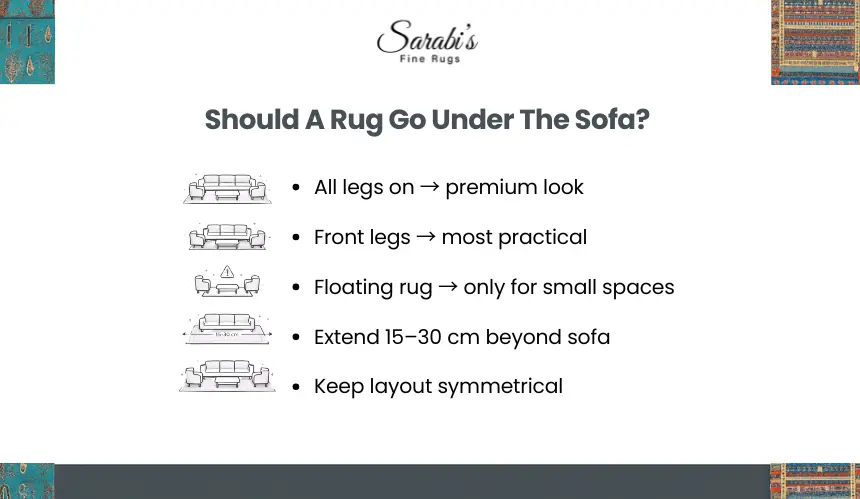
This is one of the most common layout questions in living room design. The short answer is yes, at least partially. A rug should interact with your sofa and seating arrangement to create cohesion. When furniture floats completely off the rug, the space often feels visually disconnected.
The extent of coverage depends on room size, rug dimensions, and furniture layout.
All Legs On The Rug Layout; The Designer Standard
This layout is often used in larger living rooms or formal spaces. All legs of sofas, chairs, and sometimes even side tables sit fully on the rug.
Best suited for:
- Large rooms
- Open-plan layouts
- Sectional sofas
- Luxury or formal seating arrangements
Benefits include:
- Maximum cohesion
- Strong visual grounding
- High-end, polished appearance
This approach works best with larger rugs such as 9×12 or custom dimensions.
Front Legs On The Rug Layout; The Most Practical Approach
This is the most common and versatile configuration. Only the front legs of sofas and chairs rest on the rug, while the back legs remain on the floor.
Why this works:
- Creates a visual connection
- Requires less rug surface area
- Maintains proportion in medium rooms
Design Insight: Front-leg placement is often the ideal balance between coverage and wall clearance in standard living rooms.
This layout is typically achieved with 8×10 rugs in medium-sized spaces.
Floating Layout; When The Rug Does Not Touch The Sofa
This setup places the rug entirely under the coffee table, with all seating off the rug.
It is only appropriate when:
- The living room is very compact
- The seating arrangement is minimal
- The rug is intentionally decorative rather than structural
In most cases, floating rugs appear undersized and disrupt cohesion.
How Much Rug Should Extend Beyond The Sofa?
As a general guideline:
- Extend at least 15–30 cm (6–12 inches) beyond the sofa edges
- Ensure consistent exposure on both sides for symmetry
Uneven extension can visually skew balance and make the layout feel misaligned.
How Do You Choose The Right Rug Size For Open-Plan Layouts?
Open-plan living rooms require a different sizing strategy than enclosed spaces. Without walls to define boundaries, rugs act as visual anchors that separate functional zones. The right rug size helps organize the layout, while the wrong size can fragment the space.
In open-plan homes, rugs are not just decorative; they are spatial tools.
How Do Rugs Define Zones Without Walls?
In open layouts that combine living, dining, and kitchen areas, rugs establish clear activity zones.
Each rug should:
- Anchor one functional area
- Fully contain the furniture within that zone
- Maintain clear spacing between adjacent zones
Avoid using multiple small rugs scattered across the floor. This breaks visual continuity and makes the layout feel cluttered.
Did You Know?
Design psychology shows that clearly defined zones improve spatial clarity and make large rooms feel more organized and intentional.
How Should You Size Rugs For Sectional Sofas?
Sectionals often dominate open-plan living areas. Because of their scale, they require proportionally larger rugs.
Sizing rule for sectionals:
- The rug should extend at least 20–30 cm (8–12 inches) beyond the outer edges
- Ideally accommodate front legs, or all legs, of the sectional
Undersized rugs beneath sectionals exaggerate imbalance and shrink the perceived seating area.
How Do You Maintain Balance Between Living And Dining Zones?
When living and dining areas share one large room:
- Leave at least 90 cm (36 inches) between rug edges to preserve visual separation
- Ensure dining chairs remain fully on the dining rug, even when pulled out
Dining rug sizing tip:
Add at least 60 cm (24 inches) beyond the dining table on all sides to accommodate chair movement.
This prevents uneven surfaces and maintains flow between zones.
Should Open-Plan Spaces Use Larger Rugs?
In most cases, yes. Larger rugs create:
- Continuous visual flow
- Stronger furniture anchoring
- Expanded spatial perception
Small rugs in open layouts often look lost and fail to define boundaries effectively.
How Does Traffic Flow Affect Rug Placement In Open Plans?
Because open layouts often include high foot traffic between the kitchen and living zones:
- Avoid placing rug edges directly in walking paths
- Maintain at least 75–90 cm of clear passage
Proper placement prevents tripping hazards and preserves the rug’s long-term condition.
What Rug Size Mistakes Should You Avoid?
Even with measurement guidelines and standard sizing references, certain mistakes consistently undermine living room layouts. These errors often make rooms feel disjointed, cramped, or poorly planned, even when furniture and décor are well chosen.
Avoiding these pitfalls ensures your rug enhances proportion rather than disrupting it.
Choosing A Rug That Is Too Small
This is the most common mistake. A rug that only fits beneath the coffee table, without interacting with surrounding furniture, creates visual fragmentation. The seating area appears disconnected, and the room can feel smaller than it actually is.
In most living rooms, the rug should anchor at least the front legs of sofas and chairs. When in doubt, selecting a slightly larger rug typically produces a more cohesive result.
Ignoring The Seating Footprint
Many homeowners measure wall-to-wall dimensions but forget to account for the actual seating arrangement. The rug should relate directly to the outer edges of the furniture grouping rather than the room perimeter.
If the rug does not extend sufficiently beyond the sofa edges, the layout can appear compressed or misaligned. Measuring the furniture footprint first prevents this imbalance.
Eliminating Proper Wall Clearance
Placing a rug too close to the walls removes visual framing and can make the space feel heavy. Leaving appropriate clearance, generally 30–45 cm in medium rooms, creates balance and maintains proportional harmony.
Too little clearance can make the rug look like fitted carpet, while too much can make it look undersized.
Blocking Doorways Or Traffic Paths
Rugs should not interfere with natural movement. When edges sit directly in walkways or prevent doors from opening smoothly, both comfort and safety are compromised.
Proper clearance planning preserves flow and reduces wear along high-traffic edges.
Misjudging Pattern Scale Relative To Size
Pattern size should complement rug dimensions. Large motifs on small rugs can feel overwhelming, while very small repetitive patterns on large rugs may appear visually busy.
Proportion applies not only to size but also to design scale. Ensuring alignment between rug dimensions and pattern density strengthens overall balance.
Frequently Asked Questions
What Is The Most Popular Rug Size For A Living Room?
An 8×10 rug is the most commonly recommended size for standard living rooms. It typically allows the front legs of sofas and chairs to sit on the rug while maintaining proper wall clearance. However, larger rooms or sectionals may require 9×12 or custom dimensions.
Should All Furniture Legs Be On The Rug?
Not necessarily. In most medium-sized living rooms, placing only the front legs of sofas and chairs on the rug creates strong visual cohesion. In larger spaces, placing all legs on the rug can create a more formal, unified appearance.
How Far Should A Rug Be From The Walls?
In most living rooms, leaving 30–45 cm (12–18 inches) of exposed flooring between the rug and walls creates balanced framing. Smaller rooms may require slightly less clearance, while larger rooms can accommodate wider borders.
Can A Rug Be Too Large For A Living Room?
Yes. If a rug extends too close to walls or overlaps architectural features awkwardly, it can compress visual space. Proper clearance and a balanced layout are essential to prevent the room from feeling crowded.
What Rug Size Works Best For A Sectional Sofa?
Sectional sofas typically require larger rugs, such as 9×12 or custom sizes. The rug should extend at least 20–30 cm beyond the outer edges of the sectional and anchor the front legs, or all legs in spacious layouts.
How Do I Test Rug Size Before Buying?
You can outline the intended rug dimensions using painter’s tape on the floor. This allows you to visualize proportion, check wall clearance, and confirm furniture anchoring before making a purchase.