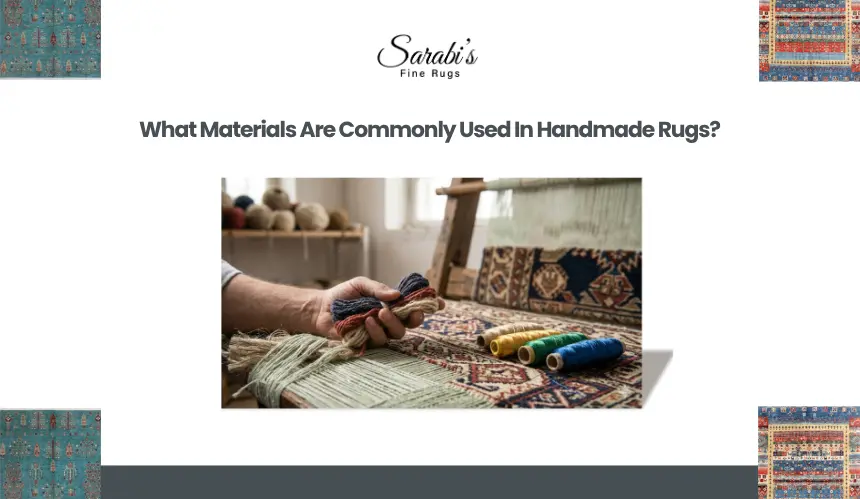
Quick Answer: Handmade rugs are commonly made from wool, silk, cotton, jute, hemp, hair-on-hide, and sometimes synthetic fibres. Wool is the most durable and widely used, silk adds luxury detailing, cotton forms the foundation, plant fibres offer sustainability, and synthetics provide affordability.
When choosing a handmade rug, material matters as much as design. While patterns and colours often attract initial attention, the fibres beneath the surface determine durability, comfort, maintenance, and long-term performance. A rug woven from premium wool behaves very differently from one made of silk, jute, hair-on-hide, or synthetic fibre. Understanding these differences is essential for making an informed investment.
Handmade rugs are crafted using a combination of pile materials, the visible surface fibres, and foundation materials such as warp and weft threads that provide structural stability. The interaction between these components affects everything from knot retention and elasticity to dye absorption and lifespan. For example, wool’s natural lanolin content offers resilience and stain resistance, while silk provides sheen and intricate pattern detailing but requires more delicate care.
Beyond performance, material choice also influences sustainability, climate adaptability, and tactile experience. Plant-based fibres like jute and hemp appeal to eco-conscious buyers, hair-on-hide rugs introduce organic texture and pattern variation, and synthetic fibres offer affordability with varying levels of durability. Each option serves a different purpose depending on lifestyle, traffic levels, and design goals.
Why Does Material Choice Matter In Handmade Rugs?
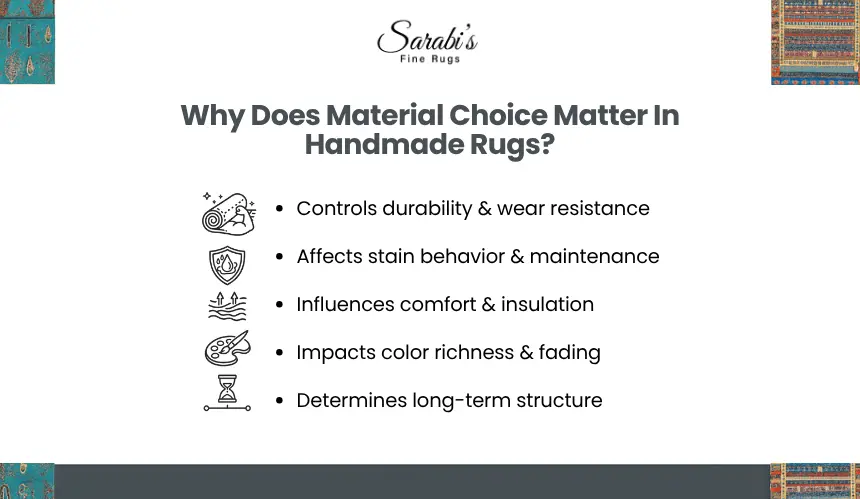
Material selection influences nearly every performance aspect of a handmade rug. From how it feels underfoot to how long it maintains structure, fibre composition determines durability, stain resistance, elasticity, maintenance needs, and overall lifespan. Two rugs may look visually similar, yet perform very differently depending on the fibres used.
Understanding material function begins with distinguishing between pile fibres and foundation fibres.
What Is The Difference Between Pile And Foundation Materials?
In handmade rugs, the pile refers to the visible surface fibres that form the texture and design. Common pile materials include wool, silk, hair-on-hide, jute, and certain synthetic fibres.
The foundation consists of warp (vertical) and weft (horizontal) threads that hold the knots in place. Cotton is commonly used in the foundation because of its dimensional stability and strength.
The performance of a rug depends on how these two components interact. A strong cotton foundation, combined with resilient wool pile, provides long-term structural integrity.
How Does Fibre Structure Influence Durability?
Each fibre type has a distinct internal structure that affects resilience.
For example:
- Wool fibres are naturally crimped, allowing them to compress and recover repeatedly.
- Silk fibres are smooth and strong but less abrasion-resistant.
- Jute fibres are coarse and less elastic.
- Synthetic fibres resist moisture but lack natural recovery.
Did You Know?
Wool fibres can stretch up to 30% of their original length without breaking, contributing to excellent compression recovery in high-traffic areas.
Durability is therefore not just about thickness but about fibre elasticity and tensile strength.
How Does Material Affect Dye Absorption And Colour Longevity?
Handmade rugs often use vegetable or natural dyes. The fibre must absorb and retain colour evenly for long-term vibrancy.
Wool absorbs natural dyes effectively, producing rich, layered tones. Silk reflects light differently, enhancing colour depth and pattern precision. Synthetic fibres may hold colour uniformly but lack the nuanced variation seen in natural fibres.
Material composition directly impacts:
- Colour richness
- Fade resistance
- Abrash variation
- Long-term tonal stability
How Does Material Choice Influence Comfort And Insulation?
Natural fibres such as wool provide insulation by trapping air within their structure. This improves thermal regulation and acoustic softness.
Hair-on-hide rugs provide a unique texture but less cushioning. Jute offers a natural texture but a firmer underfoot feel. Synthetic fibres vary widely in softness depending on manufacturing quality.
Material choice, therefore, affects both physical comfort and acoustic absorption.
How Does Climate Impact Material Performance?
Climate conditions influence fibre longevity. In humid environments, breathable natural fibres often perform better than moisture-trapping synthetics. Wool regulates humidity effectively, while plant fibres like jute may be more sensitive to prolonged exposure to moisture.
Understanding environmental compatibility helps prevent premature fibre degradation.
1. Why Is Wool The Most Widely Used Material In Handmade Rugs?
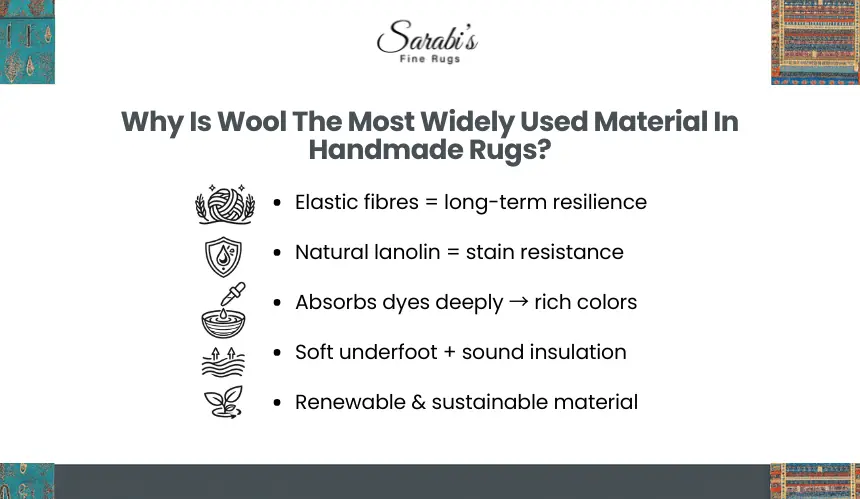
Wool is the most common and historically significant material used in handmade rugs. Across Persian, Turkish, Afghan, and Indian weaving traditions, wool has remained the dominant pile fibre due to its resilience, dye compatibility, comfort, and long-term durability. Its natural structure makes it uniquely suited for hand-knotting and high-traffic use.
While other fibres offer luxury or sustainability advantages, wool consistently delivers balanced performance.
How Does Wool Fibre Structure Enhance Durability?
Wool fibres contain a natural crimp, meaning they are slightly wavy rather than straight. This structure allows them to compress under weight and then recover to their original shape.
This elasticity provides:
- Strong compression recovery
- Resistance to flattening
- Long-term pile resilience
- Reduced visible wear in traffic zones
Did You Know?
Wool fibres can bend thousands of times and stretch up to 30% of their length without breaking. This makes wool particularly suitable for living rooms and hallways with frequent foot traffic.
High-quality hand-spun wool further enhances texture depth and durability.
Why Is Wool Naturally Stain Resistant?
Wool contains lanolin, a natural oil that repels moisture and dirt. This makes wool rugs more forgiving when exposed to spills compared to many synthetic alternatives.
Benefits include:
- Slower liquid absorption
- Easier blot cleaning
- Resistance to dust accumulation
Although no rug is completely stain-proof, wool’s structure gives it a practical advantage in everyday environments.
How Does Wool Support Rich Dye Absorption?
Wool fibres absorb vegetable and natural dyes exceptionally well. This allows for:
- Deep colour saturation
- Subtle tonal variation
- Long-lasting vibrancy
- Natural abrash effects
Unlike synthetic fibres that often produce flat, uniform colouring, wool enhances dimension through layered dye absorption. This contributes to the visual richness associated with traditional handmade rugs.
Does Wool Provide Thermal And Acoustic Benefits?
Yes. Wool fibres trap air within their structure, which improves insulation and sound absorption.
This results in:
- Warmer underfoot feel
- Reduced echo in large rooms
- Improved comfort in hard-floor spaces
In cooler climates or rooms with timber and stone flooring, wool rugs enhance thermal comfort without additional insulation layers.
Is Wool A Sustainable Material?
Wool is a renewable fibre sourced from sheep and is biodegradable under natural conditions. When responsibly sourced, it aligns with environmentally conscious design principles.
Compared to petroleum-based synthetic fibres, wool has:
- Lower long-term environmental impact
- Natural decomposition ability
- Reduced reliance on chemical processing
Sustainability depends on sourcing and production methods, but wool remains one of the most eco-aligned traditional rug materials.
2. When And Why Is Silk Used In Handmade Rugs?
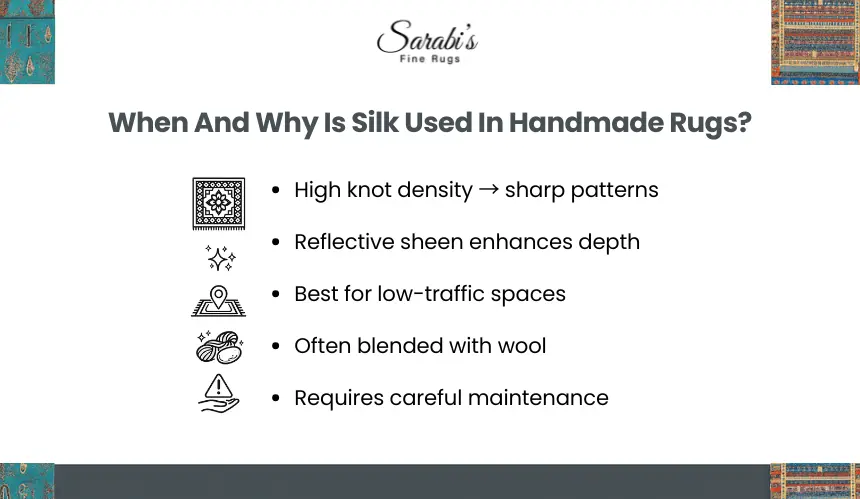
Silk is associated with refinement, precision, and luxury in handmade rug craftsmanship. While wool dominates in durability-focused designs, silk is prized for its sheen, fine texture, and ability to produce highly detailed patterns. Silk rugs are often considered investment-grade textiles due to their intricate knotting and luminous finish.
However, silk performs differently from wool and requires more deliberate placement and care.
How Does Silk Enhance Pattern Precision?
Silk fibres are thinner and smoother than wool, allowing weavers to tie tighter, more compact knots. This increases knot density and enables intricate design detailing.
Higher knot density results in:
- Sharper motif definition
- More complex floral and medallion patterns
- Finer border detailing
Did You Know?
Silk has extremely high tensile strength relative to its weight, allowing it to support detailed weaving without immediate structural failure.
This is why silk is commonly used in high-end Persian and Turkish rugs featuring elaborate motifs.
Why Does Silk Produce A Distinctive Sheen?
Silk fibres reflect light differently from wool. Their smooth surface creates natural luminosity, causing patterns to shift subtly with the viewing angle.
This reflective quality:
- Enhances colour depth
- Creates dimensional movement
- Elevates decorative impact
In well-lit spaces, silk rugs can display tonal variation simply by varying light exposure.
Is Silk Durable Enough For High-Traffic Areas?
Silk is strong in tensile strength but less abrasion-resistant than wool. This means it can withstand tension during weaving but is more prone to surface wear from repeated foot traffic.
For this reason:
- Full silk rugs are best suited for low-traffic rooms
- Decorative or formal living areas are ideal
- Heavy-use hallways are not recommended
Silk rugs require careful maintenance to preserve the integrity of the fibres.
How Are Silk And Wool Combined In Handmade Rugs?
Many handmade rugs blend silk with wool to balance durability and luxury.
In wool-silk blends:
- Wool provides structural resilience
- Silk highlights enhance pattern detailing
- Sheen is introduced without sacrificing strength
Silk is often used selectively in borders or motifs to emphasize design features while maintaining wool as the primary pile fibre.
Does Silk Require Special Maintenance?
Yes. Silk rugs are more sensitive to moisture and harsh cleaning agents. Professional cleaning is typically recommended to prevent fibre damage.
Silk’s delicate nature means:
- Avoid excessive moisture
- Minimize direct sunlight exposure
- Use gentle vacuum settings
Proper care preserves the fibre’s sheen and structural stability.
3. What Role Does Cotton Play In Handmade Rug Construction?
While cotton is not usually the visible surface of a handmade rug, it plays a critical structural role. In most traditional hand-knotted rugs, cotton forms the foundation, providing stability, shape retention, and support for the pile fibres. Without a strong foundation, even the highest-quality wool or silk pile would lack long-term structural integrity.
Understanding cotton’s function helps clarify the difference between surface materials and construction materials.
How Do Warp And Weft Threads Use Cotton?
In handmade rugs, the foundation consists of:
- Warp threads (vertical strands running lengthwise)
- Weft threads (horizontal strands woven between knots)
Cotton is commonly used for these threads because it provides strength without excessive elasticity. This dimensional stability ensures the rug maintains its shape over time.
The pile fibres, such as wool or silk, are tied around these cotton warp threads, locking each knot securely in place.
Why Is Cotton Ideal For Structural Stability?
Cotton fibres offer:
- Low stretch
- Strong tensile support
- Consistent thickness
- Reliable knot anchoring
Because cotton does not expand and contract excessively, it helps prevent distortion. This is especially important in larger rugs where structural balance must be preserved across the entire surface.
Did You Know?
A stable cotton foundation improves knot retention, meaning the rug resists loosening even under heavy use.
This makes cotton essential for long-term durability.
Is Cotton Ever Used As The Pile Material?
In most high-quality handmade rugs, cotton is rarely used as the pile. It lacks the elasticity and softness of wool and does not provide the same durability in high-traffic areas.
However, cotton may be used:
- In flatweave rugs such as kilims
- In lighter decorative pieces
- In lower-cost handmade constructions
When used as a pile, cotton rugs generally feel firmer and wear more quickly compared to wool.
How Does Cotton Affect Maintenance And Longevity?
Cotton foundations can be sensitive to prolonged exposure to moisture. Excess humidity or improper cleaning may affect structural integrity if not managed properly.
To preserve longevity:
- Avoid excessive water during cleaning
- Ensure proper drying after professional washing
- Maintain good airflow in humid environments
Proper care ensures the cotton foundation continues to securely support the rug’s pile.
4. What Is Hair-On-Hide, and When Is It Used In Handmade Rugs?
Hair-on-hide rugs differ structurally and visually from traditional hand-knotted wool or silk rugs. Instead of woven pile fibres, these rugs use treated animal hides, most commonly cowhide, with the hair left intact. The result is a natural surface with organic pattern variation, texture, and tonal depth.
While the cutting, stitching, and finishing processes are technically handmade, hair-on-hide rugs are constructed differently from knotted or woven textiles.
How Is Hair-On-Hide Constructed?
Unlike woven rugs, hair-on-hide rugs are made from:
- Tanned animal hides
- Cut panels stitched together
- Natural hide backings
In patchwork designs, multiple hide sections are sewn into geometric layouts. In full-hide rugs, a single hide forms the entire surface.
Because there are no warp and weft threads, structural stability depends on hide thickness and tanning quality rather than knot density.
What Makes Hair-On-Hide Visually Unique?
Hair-on-hide rugs feature natural markings that cannot be replicated synthetically. Each hide contains:
- Organic colour variation
- Natural speckling
- Unique tonal gradients
This makes every piece one-of-a-kind.
Did You Know?
No two cowhide rugs are identical, as natural hide patterns vary across each animal.
The texture also differs significantly from wool rugs, offering a smooth yet slightly coarse tactile experience.
Is Hair-On-Hide Durable?
Hair-on-hide can be durable when used appropriately, but performance depends heavily on placement.
Best suited for:
- Low-traffic living areas
- Bedrooms
- Decorative layering
Not ideal for:
- High-traffic hallways
- Moisture-prone areas
- Heavy furniture compression
Repeated friction can cause hair shedding over time.
How Does Hair-On-Hide Respond To Moisture And Maintenance?
Hair-on-hide rugs are sensitive to excessive moisture. While properly tanned hides resist moderate exposure, prolonged dampness may affect backing integrity.
Maintenance guidelines include:
- Gentle vacuuming without a rotating brush
- Avoiding steam cleaning
- Spot cleaning with minimal moisture
Direct sunlight should also be limited to prevent fading or drying of the hide.
When Is Hair-On-Hide Chosen Over Woven Rugs?
Hair-on-hide is often selected for aesthetic reasons rather than structural longevity.
It complements:
- Modern interiors
- Minimalist designs
- Rustic or industrial spaces
Because it lies flatter than woven rugs, it adds texture without heavy pile height.
5. Are Plant-Based Fibres Like Jute And Hemp Durable In Handmade Rugs?
Plant-based fibres such as jute and hemp are increasingly used in handmade rugs due to their sustainability, texture, and natural aesthetic. Unlike wool or silk, these fibres are derived from plant stems rather than animal sources. Their performance characteristics differ significantly, making them suitable for specific environments and design goals.
Understanding their strengths and limitations helps determine where they perform best.
What Makes Jute And Hemp Environmentally Attractive?
Jute and hemp are considered eco-friendly because they are:
- Rapidly renewable crops
- Biodegradable under natural conditions
- Less resource-intensive compared to synthetic production
Hemp, in particular, requires relatively low pesticide use and minimal water compared to many conventional crops.
This makes plant-based rugs appealing to buyers prioritizing sustainable home materials.
How Do Jute And Hemp Compare To Wool In Durability?
While jute and hemp are strong fibres, they lack the elasticity found in wool. Wool’s natural crimp allows it to compress and recover, whereas plant fibres are more rigid.
This results in:
- Lower compression recovery
- Firmer underfoot feel
- Reduced resilience in high-traffic zones
Did You Know?
Wool’s natural elasticity allows it to spring back after repeated foot traffic, while jute fibres tend to flatten permanently under pressure.
Because of this, jute and hemp rugs are generally better suited for moderate or low-traffic areas.
How Do Plant-Based Fibres Perform In Humid Environments?
Jute and hemp are absorbent fibres. While breathable, they are more sensitive to prolonged moisture exposure compared to wool.
In humid conditions:
- Fibres may weaken over time
- Mold risk increases if not properly ventilated
- Staining may be harder to manage
Proper placement in dry, well-ventilated spaces is important for longevity.
What Is The Tactile And Visual Appeal Of Jute And Hemp?
Plant-based rugs are often chosen for their organic texture and understated appearance. They typically feature:
- Neutral, earthy tones
- Braided or flatweave construction
- Coarse, natural texture
Their aesthetic complements:
- Coastal interiors
- Minimalist spaces
- Organic or bohemian design schemes
Unlike wool rugs, which provide softness and cushioning, jute and hemp deliver a more structured surface feel.
When Should You Choose A Plant-Based Handmade Rug?
Jute and hemp rugs work well in:
- Bedrooms
- Decorative layering applications
- Low-traffic living areas
- Sunrooms with good ventilation
They are less suitable for heavily trafficked family rooms or areas exposed to frequent spills.
6. Are Synthetic Fibres Used In Handmade Rugs?
While traditional handmade rugs are typically associated with natural fibres such as wool and silk, synthetic fibres are sometimes used in modern handmade or hand-tufted constructions. These materials are often introduced to reduce cost, enhance stain resistance, or achieve specific colour consistency. However, their performance characteristics differ significantly from natural fibres.
Understanding where synthetics fit, and where they fall short, is essential.
What Types Of Synthetic Fibres Are Commonly Used?
The most common synthetic fibres found in handmade-style rugs include:
- Polypropylene
- Polyester
- Nylon
These fibres are petroleum-based and engineered for uniformity. They are frequently used in hand-tufted rugs or hybrid constructions rather than traditional hand-knotted pieces.
How Do Synthetic Fibres Compare In Durability?
Synthetic fibres vary in performance, but most lack the natural elasticity of wool. While they resist moisture and staining effectively, they do not compress and recover as naturally as fibres do.
Performance characteristics typically include:
- Good resistance to spills
- Lower compression recovery
- Greater tendency to flatten over time
- Reduced repairability compared to wool
Did You Know?
Unlike wool, which can stretch and recover due to its crimped structure, most synthetic fibres have limited natural rebound, leading to visible wear in high-traffic areas.
Durability may be adequate for short- to medium-term use, but often does not match the lifespan of high-quality wool rugs.
Do Synthetic Fibres Offer Better Stain Resistance?
Synthetic fibres are often marketed as stain-resistant because they repel moisture and are less absorbent than natural fibres. This makes them easier to clean in some cases.
However:
- Oil-based stains may still penetrate
- Fibre pilling can occur
- Surface sheen may dull unevenly
While synthetics resist liquid absorption, they lack the natural dirt-repelling properties of lanolin found in wool.
How Do Synthetic Rugs Affect Environmental Impact?
Synthetic fibres are derived from petrochemicals and are not biodegradable under normal conditions. While some manufacturers incorporate recycled materials, environmental impact remains a consideration.
Compared to renewable fibres such as wool or plant-based materials, synthetics generally:
- Require more chemical processing
- Have longer landfill persistence
- Offer limited recyclability after use
This influences purchasing decisions for environmentally conscious buyers.
Are Synthetic Fibres Ever Blended With Natural Materials?
Yes. Some rugs combine wool with synthetic fibres to lower cost while maintaining partial durability. However, blends may affect dye absorption and long-term resilience.
In many cases, synthetic blends are used in:
- Hand-tufted rugs
- Decorative accent pieces
- Budget-friendly alternatives
It is important to distinguish between traditional hand-knotted construction and modern handmade-style rugs that incorporate synthetics.
How Do Material Blends Improve Performance In Handmade Rugs?
Material blending allows rug makers to combine the strengths of different fibres while minimizing their weaknesses. Instead of relying on a single fibre type, blends create performance balance, improving durability, enhancing sheen, controlling cost, or optimizing texture.
Blended rugs are especially common in high-end handmade production where both structural integrity and visual refinement are priorities.
How Do Wool-Silk Blends Balance Strength And Luxury?
One of the most common premium combinations is wool blended with silk.
In this structure:
- Wool provides elasticity and abrasion resistance
- Silk enhances detail, precision, and luminosity
- The foundation (often cotton) maintains structural stability
Silk may be used selectively in motifs or borders to highlight design elements while wool forms the primary pile. This preserves durability while introducing a subtle sheen.
Did You Know?
Using silk only in high-detail areas allows for finer knotting without compromising overall traffic performance.
This hybrid approach is frequently seen in Persian and Indo-Persian handmade rugs.
How Do Blends Improve Cost Efficiency?
Blending fibres can reduce production cost without sacrificing structural integrity.
For example:
- Partial silk inclusion lowers full-silk expense
- Limited synthetic blending may reduce price while retaining wool characteristics
However, cost efficiency should not compromise long-term performance. The balance between price and durability depends on the proportion of fibres used.
Can Blends Improve Texture And Visual Depth?
Yes. Different fibres reflect light differently. Wool has a matte finish, while silk reflects light more vividly. Combining them creates dimensional contrast within the same rug.
This results in:
- Enhanced pattern definition
- Subtle tonal movement
- Greater visual complexity
Blended fibres allow designers to manipulate surface appearance while maintaining structural resilience.
Do Blends Affect Durability And Maintenance?
Performance depends on the dominant fibre. If wool forms the majority of the pile, the rug retains strong elasticity and recovery. If the silk content is high, the rug may require more careful placement.
Maintenance considerations include:
- Avoiding excessive moisture on silk-heavy rugs
- Using gentle vacuum settings
- Professional cleaning for blended high-density pieces
Blends require an understanding of fibre proportions rather than assuming uniform performance.
When Are Blended Handmade Rugs Most Practical?
Blended rugs are ideal when homeowners want:
- Luxury aesthetics with moderate traffic durability
- Decorative focal pieces
- Balanced cost-to-performance ratio
- Enhanced pattern detail without sacrificing structure
They serve as a bridge between purely functional wool rugs and purely decorative silk rugs.
Which Handmade Rug Material Is Best For Different Lifestyles?
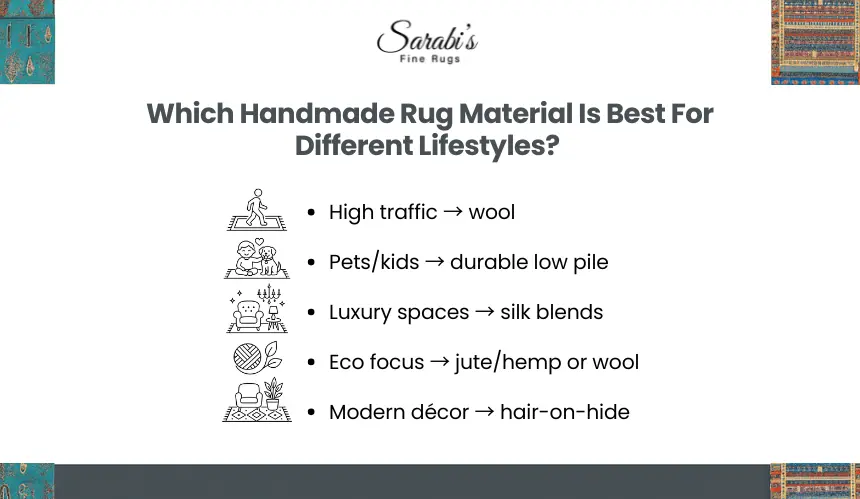
The best material for a handmade rug depends less on appearance and more on how the space is used. Traffic levels, pets, climate, maintenance habits, and aesthetic priorities all influence the ideal fibre choice. No single material is universally “best”; performance must align with lifestyle.
For High-Traffic Living Areas
Wool is typically the most practical choice. Its natural elasticity allows it to compress and recover under repeated foot traffic, and its lanolin content offers mild stain resistance. For family rooms, hallways, and frequently used living spaces, wool provides the strongest balance of durability and comfort.
Blended wool-silk rugs can work in moderately trafficked areas, but rugs with a high silk content should be avoided in heavily used zones.
For Homes With Pets Or Children
Durability and cleanability become primary concerns. Wool remains a strong option because it resists crushing and is easier to maintain than delicate fibres. Lower pile height also improves long-term performance and simplifies cleaning.
Silk and hair-on-hide are less suitable for active households due to their sensitivity to abrasion and potential wear.
For Luxury Or Formal Spaces
Silk or wool-silk blends are ideal in formal sitting rooms, master bedrooms, or decorative spaces with limited foot traffic. Silk enhances pattern detail and creates luminous depth, but it requires mindful placement and maintenance.
These materials prioritize visual refinement over heavy-duty resilience.
For Eco-Conscious Buyers
Plant-based fibres such as jute and hemp appeal to sustainability-focused buyers. They are biodegradable and renewable, offering a natural aesthetic. However, they perform best in low-traffic, dry environments due to lower elasticity and moisture sensitivity.
Responsibly sourced wool also remains an environmentally aligned option.
For Modern Or Minimalist Interiors
Hair-on-hide rugs suit contemporary, industrial, or minimalist spaces. They provide organic texture and natural pattern variation but function best as accent pieces rather than primary high-traffic flooring.
Frequently Asked Questions
What Is The Most Durable Material For A Handmade Rug?
Wool is generally the most durable material used in handmade rugs. Its natural elasticity allows it to recover from compression, making it ideal for high-traffic areas such as living rooms and hallways. High-quality wool rugs can last for decades with proper care.
Are Silk Handmade Rugs Practical For Everyday Use?
Silk rugs are better suited for low-traffic or formal spaces. While silk has high tensile strength, it is more sensitive to abrasion than wool. Many handmade rugs use silk as accent detailing rather than as the primary pile in heavily used rooms.
Is Cotton Used In The Surface Of Handmade Rugs?
Cotton is most commonly used in the foundation, the warp and weft threads, rather than the pile. It provides structural stability and knot anchoring. Cotton pile is more common in flatweave rugs but is less durable than wool for high-traffic use.
Are Hair-On-Hide Rugs Considered Handmade?
Hair-on-hide rugs are handmade by tanning, cutting, and stitching, but they are not woven like hand-knotted rugs. They offer unique natural patterns and textures but are best placed in low-traffic areas.
Are Synthetic Fibres Used In Handmade Rugs?
Some modern handmade or hand-tufted rugs incorporate synthetic fibres, such as polypropylene or polyester, to reduce costs or improve stain resistance. However, they typically do not match the longevity and elasticity of natural fibres like wool.
Which Material Is Best For Homes With Pets?
Wool is generally the most practical option due to its resilience and ease of maintenance. Lower pile height and dense knotting also improve durability in active households.