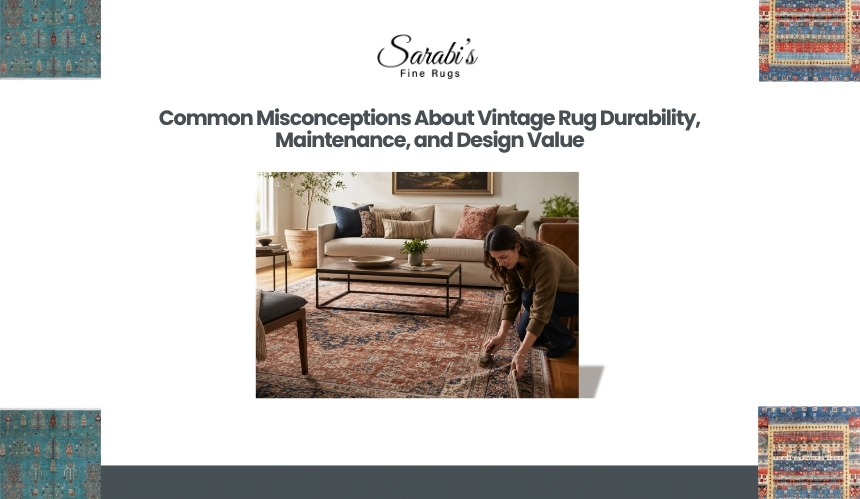
Vintage rugs are often misunderstood because age is commonly associated with weakness, fading, or poor usability. Many buyers assume older rugs cannot handle daily foot traffic, require difficult maintenance, or only suit traditional interiors. In reality, many vintage rugs remain highly functional because of their handmade construction and dense weaving techniques.
Shopping for one? See our vintage rugs in Sydney at our North Willoughby showroom.
Long-term durability: Many hand-knotted rugs are built to last for decades, and well-maintained pieces can remain usable for 50 to 100 years or more. That makes vintage rugs closer to long-term home assets than short-life decor.
Many Persian, Turkish, and Oriental rugs were originally woven for long-term household use rather than short manufacturing cycles. Some hand-knotted rugs contain hundreds of knots per square inch, creating a tighter structure that resists wear more effectively than many machine-made alternatives. Natural wool fibers also contain lanolin, which helps repel dirt and reduce fiber deterioration over time.
This blog explores common myths surrounding vintage rug durability, fading, maintenance, cleanliness, design compatibility, and pricing. It explains how handmade construction, natural materials, and aging characteristics influence the long-term performance and practicality of vintage rugs in modern interiors.
1. Are Vintage Rugs Too Fragile for Everyday Use?
Vintage rugs are not automatically fragile simply because they are older. Many handmade rugs were originally produced for heavy residential use and can continue performing well for decades when their weave structure and fiber condition remain intact.
Hand-knotted rugs are often more structurally stable than many modern machine-made options because their knots are individually tied instead of mechanically bonded. Dense weaving distributes pressure more evenly across the rug surface, which helps reduce premature fiber separation in high-traffic areas.
Knot density matters: Handmade rugs can range from about 50 to 400 knots per square inch, with finer pieces reaching even higher. Higher density usually means a tighter weave and stronger resistance to wear.
How Hand-Knotted Construction Improves Longevity
Hand-knotted construction creates a tighter and more flexible rug foundation that can tolerate long-term use more effectively than glued or machine-stitched backing systems. Each knot contributes to the rug’s structural integrity, making localized wear less likely to compromise the entire surface.
This weaving method also allows many vintage rugs to survive repeated cleaning, furniture pressure, and foot traffic without rapid deterioration. In many cases, properly maintained handmade rugs outlast synthetic rugs produced through mass manufacturing.
Why Wool Fibers Resist Wear Naturally
Wool fibers naturally contain elasticity that helps the rug recover from compression caused by walking or furniture weight. This resilience allows vintage wool rugs to maintain texture and structure longer than many synthetic fiber alternatives.
Natural wool also contains lanolin, which helps resist dirt absorption and limits fiber dryness over time. Because of this, many vintage wool rugs continue performing well even after decades of regular indoor use.
Wool behavior: Wool contains lanolin, which helps fibers shed soil more easily and resist drying out over time. That is one reason wool vintage rugs often keep their texture and appearance longer than synthetic alternatives.
2. Does Fading Always Mean a Vintage Rug Is Low Quality?
Fading does not always indicate poor rug quality or structural damage. In many vintage rugs, color variation develops naturally through age, sunlight exposure, vegetable dye oxidation, and long-term use rather than fiber failure.
Many handmade rugs were dyed using natural pigments that age gradually over time instead of maintaining a perfectly uniform color. This soft tonal variation is often considered part of the rug’s character and can increase its visual depth in both traditional and modern interiors.
How Natural Dye Aging Differs From Fiber Damage
Natural dye aging changes the appearance of color without necessarily weakening the rug structure itself. Fiber damage, however, usually appears through thinning pile, exposed foundation threads, unraveling edges, or brittle material texture.
A rug can display softened or faded colors while still remaining structurally stable for everyday use. Evaluating the weave condition and foundation strength is usually more important than judging the rug only by color intensity.
Damage signals: Exposed foundation threads, thinning pile, and frayed edges are more reliable damage signals than soft color loss. That makes structural inspection more important than judging the rug only by brightness or saturation.
Why Distressed Appearance Can Increase Character
Distressed appearance is often intentionally valued because it highlights the rug’s handmade texture, aging pattern, and visual uniqueness. Slight color variation and softened contrast can help vintage rugs integrate more naturally into layered interior designs.
Many modern interiors use vintage rugs specifically because aged tones create less visual harshness than newer high-saturation patterns. This allows the rug to add texture and history without overwhelming surrounding furniture or architectural finishes.
3. Are Vintage Rugs Difficult To Maintain?
Vintage rugs do not require excessively complicated maintenance, but they do benefit from consistent care routines that protect fiber structure and color stability over time. Most maintenance problems occur when rugs are neglected, over-cleaned, or exposed to prolonged moisture and sunlight.
Compared to many synthetic rugs, handmade wool rugs often trap less surface debris because natural fibers resist static buildup more effectively. Proper rotation, controlled cleaning frequency, and stable indoor conditions usually contribute more to rug longevity than aggressive maintenance routines.
Proper Vacuuming and Rotation Practices
Routine vacuuming helps prevent dirt particles from settling deep into the rug foundation, where abrasion gradually weakens fibers. Rotation is equally important because it distributes wear patterns more evenly across the rug surface.
Basic maintenance practices typically include:
- Vacuuming without aggressive brush settings
- Rotating the rug every few months
- Keeping heavy furniture pressure balanced
- Avoiding prolonged direct sunlight exposure
- Addressing spills before moisture penetrates the foundation
When Professional Rug Cleaning Becomes Necessary
Professional cleaning becomes important when embedded dirt, odor buildup, or staining reaches beneath the surface pile. Handmade vintage rugs often require specialized washing methods that preserve natural dyes and prevent fiber shrinkage.
Overwashing can damage older fibers, but avoiding deep cleaning entirely may allow abrasive particles to weaken the rug’s foundation gradually. Cleaning intervals usually depend on foot traffic, indoor air conditions, pets, and overall usage patterns.
How Rug Padding Helps Reduce Wear
Rug padding helps reduce friction between the rug foundation and the floor surface during daily movement. This minimizes stress on the weave structure and improves overall stability in high-traffic areas.
Padding also improves weight distribution beneath furniture while reducing corner curling and edge strain. In many cases, proper underlayment significantly extends the usable lifespan of a vintage rug by limiting repetitive structural pressure.
4. Do Vintage Rugs Only Work in Traditional Interior Designs?
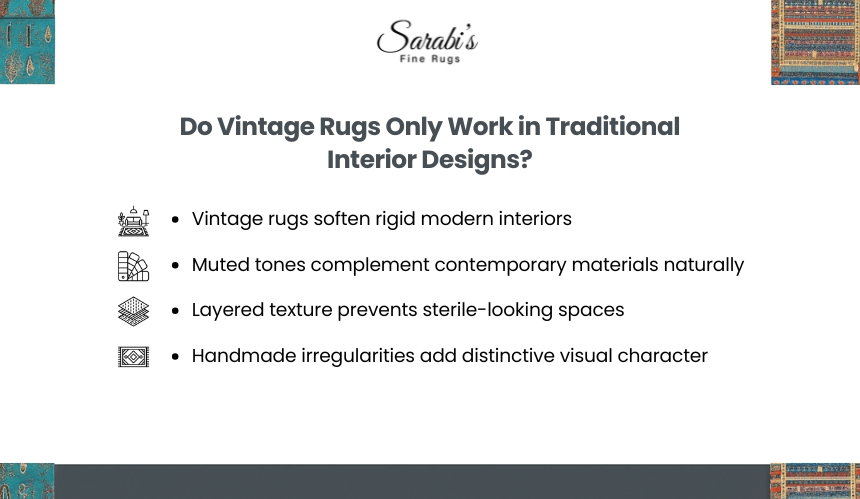
Vintage rugs are not limited to traditional interiors and are widely used in modern, minimalist, industrial, and transitional spaces. Their aged textures and softened color palettes often create visual contrast that helps contemporary interiors feel less sterile or uniform.
Many designers use vintage rugs to introduce warmth, depth, and material variation into spaces dominated by clean lines, neutral walls, and modern furniture. Handmade irregularities also add visual character that machine-made rugs often lack.
How Vintage Rugs Add Contrast to Modern Interiors
Vintage rugs help balance modern interiors by softening rigid architectural lines and adding layered texture beneath contemporary furniture. This contrast creates a more visually grounded environment without requiring excessive decorative elements.
They are commonly paired with:
- Minimalist furniture
- Neutral color palettes
- Concrete or hardwood flooring
- Contemporary lighting
- Open-concept layouts
Why Neutral Aging Tones Fit Contemporary Layouts
Many vintage rugs develop muted tones naturally through dye aging and long-term use. These softer color transitions integrate more easily into modern interiors than highly saturated patterns commonly found in newer rugs.
Faded reds, earthy browns, muted blues, and softened ivory tones often complement contemporary materials such as wood, metal, stone, and linen. This flexibility allows vintage rugs to function across multiple interior styles without dominating the overall design scheme.
5. Are Vintage Rugs Unsanitary or Unsafe for Indoor Use?
Vintage rugs are not automatically unsanitary simply because they are older. A properly cleaned and maintained vintage rug can remain safe for indoor use, especially when its fibers, foundation, and backing are free from moisture damage, mold growth, or embedded contaminants.
Many concerns about hygiene come from confusion between neglected rugs and professionally maintained handmade rugs. Dust accumulation, odor retention, and allergen buildup can occur in any rug category if cleaning routines are ignored, regardless of whether the rug is vintage or newly manufactured.
How Professional Cleaning Restores Fiber Hygiene
Professional rug cleaning removes embedded dirt, dust particles, oils, and moisture that standard surface vacuuming cannot fully extract. Handmade rugs often require specialized cleaning methods because aggressive chemical treatments may damage natural dyes or weaken older fibers.
Deep cleaning also helps reduce odor retention caused by trapped organic debris inside the rug foundation. When performed correctly, professional washing can restore airflow within the pile structure while preserving the rug’s material stability.
Why Natural Materials Behave Differently Than Synthetic Fibers
Many vintage rugs are woven from wool, cotton, or silk instead of petroleum-based synthetic fibers. Natural materials respond differently to moisture, airflow, and static buildup, which can influence how dust and debris interact with the rug surface.
Wool fibers naturally resist static electricity more effectively than many synthetic alternatives, which can reduce loose particle attraction. Proper indoor humidity control and regular maintenance further help maintain cleaner fiber conditions over long-term use.
6. Are Vintage Rugs Overpriced Compared To Modern Rugs?
Vintage rugs are not priced higher simply because they are old. Their value is usually influenced by handmade construction, material quality, knot density, dye techniques, and the amount of labor required to produce them before mass manufacturing became dominant.
Many machine-made rugs are designed for faster production cycles and shorter replacement timelines, while handmade vintage rugs were often created for long-term residential use. This difference in construction standards affects durability, repair potential, and long-term performance over time.
Pricing differences: Semi-antique and vintage Persian rugs can sell for up to 60% less than comparable antique pieces, even when the weaving quality is similar. That gap shows how much value depends on age, condition, and provenance, not age alone.
Why Handmade Construction Changes Production Value
Handmade rugs require significantly more labor than machine-produced alternatives because each knot is tied individually by skilled artisans. Depending on the weave complexity and knot density, some rugs can take months to complete.
This process creates stronger structural foundations and more detailed pattern variation that cannot be fully replicated through automated manufacturing. Material quality also plays a major role, especially in rugs woven from natural wool, silk, or cotton foundations.
How Longevity Influences Long-Term Cost Efficiency
A lower purchase price does not always translate into better long-term value. Many inexpensive synthetic rugs experience faster fiber flattening, edge separation, or backing deterioration under consistent foot traffic.
Well-maintained vintage rugs often remain usable for decades and may tolerate restoration work more effectively than mass-produced alternatives. Because of this, their higher initial cost can sometimes result in lower replacement frequency over the long term.
Frequently Asked Questions
Can a vintage rug lose value if it has been professionally repaired?
Professional restoration does not automatically reduce a vintage rug’s value when repairs preserve the original weave structure and materials. In many cases, stabilized edges, rewoven sections, or reinforced foundations help extend usability without significantly affecting authenticity. Poor-quality repairs using mismatched fibers or synthetic adhesives usually create the bigger valuation concerns.
Why do some vintage rugs feel heavier than modern rugs?
Many vintage rugs use denser knotting techniques and thicker natural fiber foundations than modern machine-made rugs. Wool, cotton, and layered handwoven construction add structural weight, especially in hand-knotted Persian or Oriental rugs. Heavier weight often reflects material density and weaving complexity rather than damage or excessive age.
Do vintage rugs perform differently on hardwood floors compared to tile?
Surface friction, humidity exposure, and floor texture can change how a vintage rug behaves over time. Hardwood floors usually require rug padding to reduce sliding and foundation abrasion, while tile surfaces may create more movement stress beneath high-traffic areas. Proper underlayment helps stabilize the rug regardless of the flooring material.
Can pet ownership damage vintage rugs faster?
Pet activity does not automatically make vintage rugs impractical, but claws, moisture accidents, and repeated abrasion can accelerate wear if maintenance is inconsistent. Wool rugs generally tolerate daily use better than delicate silk constructions because their fibers recover more effectively from compression and surface friction.
Why do some vintage rugs have uneven edges or slight asymmetry?
Handmade rugs are woven manually rather than through perfectly calibrated machine systems, which means slight dimensional irregularities are common. Minor asymmetry often reflects authentic hand-knotting techniques and loom tension variation instead of manufacturing defects or structural instability.
Are naturally dyed vintage rugs more sensitive to sunlight?
Natural dyes can gradually soften when exposed to prolonged direct sunlight, especially in areas receiving consistent UV exposure. However, gradual tonal variation differs from severe fiber damage. Rotating the rug periodically and controlling direct sunlight exposure usually helps maintain a more balanced color aging across the surface.
Looking for the real thing? Browse our vintage rugs, see them at our North Willoughby showroom, or book an in-home viewing.