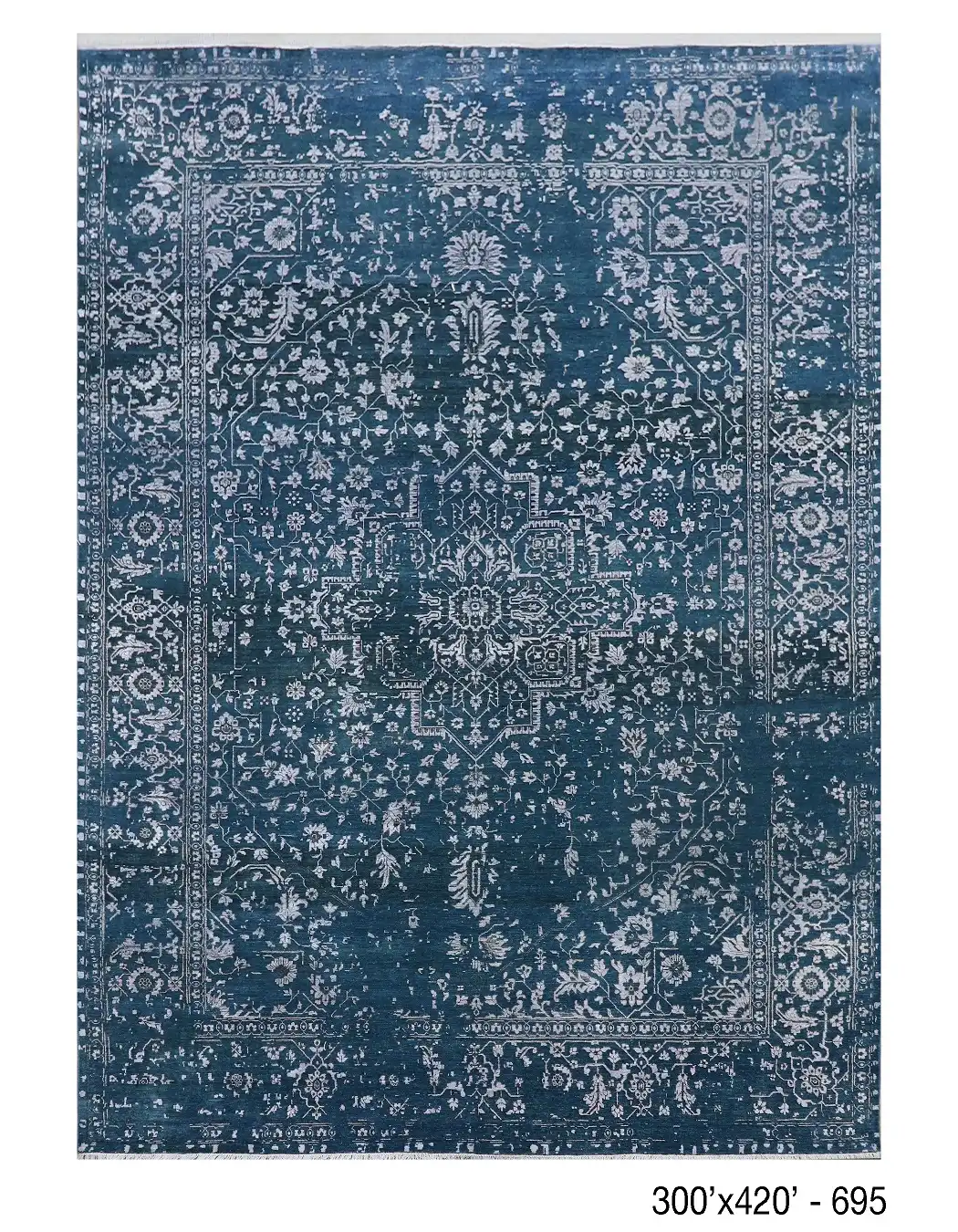
Blue Transitional Indian Rug
This blue transitional Indian rug is hand knotted in Agra, India, from New Zealand wool and measures 420 x 300 cm. Its teal ground carries silver-grey motifs, with a medallion at the centre and a broad border of flowers and vines around the edge.
The design up close
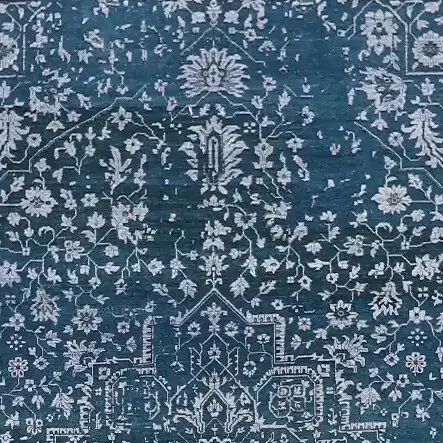
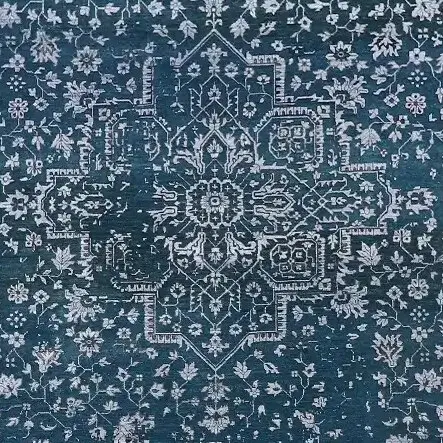
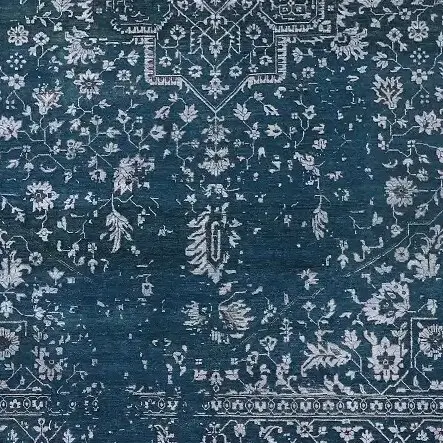
A central medallion is built from stepped, star-like shapes in silver-grey outline, with a small flower at its heart and long pendants reaching toward the short ends. Around it the field is filled with small leaves, buds and vines in the same silver-grey, set on the teal ground in no fixed rows. In this blue transitional Indian rug the motifs look softened, which gives the piece a feel between traditional and modern.
The border is divided into bands. The outer edge carries rows of tiny flowers and scrolls, and an inner band holds larger palmette-like shapes, separated from the field by a thin line of repeated motifs. The blue shifts in shade from one area to the next, a variation called abrash, so the ground has depth rather than one flat colour.
Indian rugs and their workshops
India has a long hand-knotted rug tradition, with weaving centres including Agra and the Bhadohi and Mirzapur area of Uttar Pradesh. Indian workshops weave many modern and abstract designs, often to order, in a wide range of colours and sizes. Wool is the most common pile in Indian rugs.
How a blue transitional Indian rug is made
Artisans in Agra tie each knot by hand, and the pile is then trimmed to an even height. Our records note vegetable dyes. Vegetable dyes can vary a little between batches of wool, so the blue may shift in places.
Sizing it for your room
At 420 x 300 cm this blue transitional Indian rug covers about 12.6 square metres, which suits a large living room. A three-seat sofa of about 2.2 m leaves roughly 100 cm of rug at each end, and the sofa and two armchairs can sit on it around a coffee table. Under a dining table of 240 x 100 cm, the rug leaves about 90 cm at each end and 100 cm along each side, enough for chairs to slide back.
The silver-grey and teal sit well with grey or timber floors and light walls. This blue transitional Indian rug gives a large open room a calm centre. Ivory and charcoal furniture make a calm partner for it, and a rug this size is best judged in a room where you can stand back from it.
Looking after your rug
Vacuum it on a suction-only setting, or with the beater bar switched off, so the brush does not pull at the knots. Turn it around every six to twelve months so sun and foot traffic wear it evenly. Blot spills with a clean white cloth and cold water rather than rubbing them in. When it needs a full clean, choose a cleaner who washes handmade rugs by hand.
Put a good underlay beneath it. It stops the rug sliding on timber or tiles, adds cushioning and takes some of the wear off the pile. Moths like wool in dark, quiet spots, such as the part of a rug under a sofa, so vacuum those areas often and lift the furniture now and then.
See it before you buy
Visit our showroom at 307 Penshurst St, North Willoughby, open every day from 11 am to 4:30 pm, to see this blue transitional Indian rug in person. If you would rather judge it in your own room, with your own light and furniture, book an in-home viewing and we will bring a selection to you.
Browse more Indian Rugs, or ask about a custom made rug in your own size and colour. Read more about rugs and carpets.